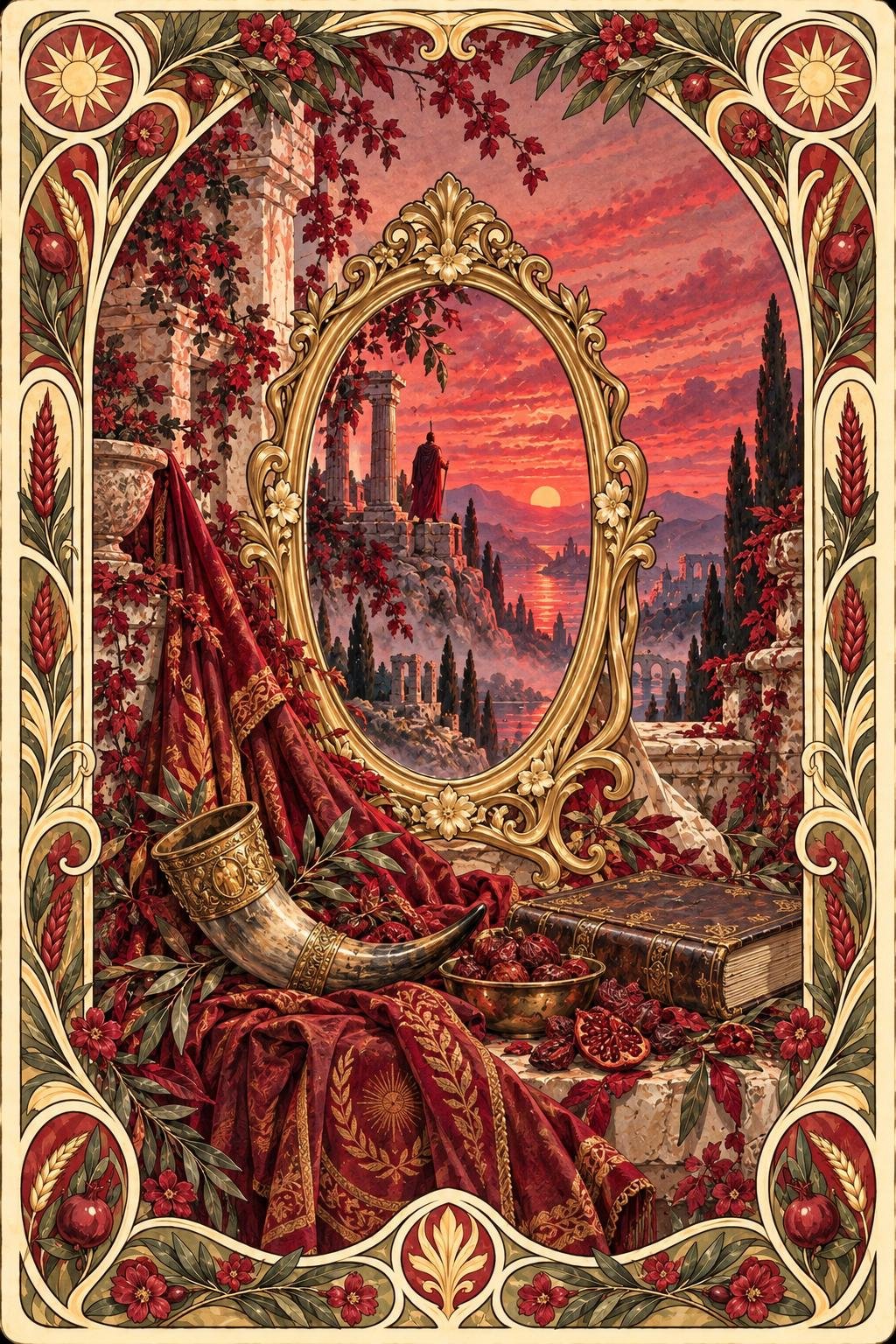
A trumpet sounds far above the clouds. Its voice, more command than song, rolls over the open earth. Below, the ground stirs. Coffins, half-buried in memory, give up their sleepers. People rise, faces lifted, hands reaching for the air. The summons is not gentle. It splits the sky and draws what has been hidden into daylight. In this stillness, the call is both a reckoning and a renewal — a moment when the world asks its old stories to stand up and answer for themselves.
Somewhere, the memory of an old battle standard ripples in the wind. Once, it was carried at the front of armies, its cloth deep and rich against the dust, calling soldiers to attention in the clash of morning. For centuries, such banners led processions through the streets of cities after victory, their fabric marked by rain and the touch of history’s hands. Those who marched beneath them felt the promise of change and the burden it brings. At the edges of the field, the kermes beetle hides on Mediterranean oaks, its hard shell coveted by merchants. Its secret is an alchemy that traveled from Persian markets to Venetian dye shops, filling clay jars that would spill, drop by drop, into boiling vats. As the horn sounds above the clouds, it seems to echo the old journeys: traders on the Silk Road, their hands stained as they count coins; dyers pressing soaked wool into barrels before it dries in the wind.
A robe, freshly washed and still damp from the river, swings on a line in a city courtyard. Its folds recall the vestments of old priests and the sashes worn by university scholars on their day of achievement. Such cloth, marked by labor and ceremony, holds the memory of hands that lifted it from water and wrung it dry, that smoothed it before the fire so its surface shone. The call that wakes the sleepers is not only for the grand and the powerful, but for those who kept their tools sharp in quiet rooms — the weaver by her loom, the tanner in the cool cellar, the needleworker tracing the outline of a pomegranate on the hem of a wedding dress.
There is a fruit that splits at harvest, its skin thick and leathery, inside packed with jewel-like seeds and sticky juice. On festival days, children race through the orchard to gather such fruit, staining their wrists and lips while laughter shakes the branches. The horn above the clouds seems to ring in such moments, when the ordinary is charged with purpose, when the world demands both attention and gratitude. The scent of spiced wine lingers after the feast, and in the kitchen, a mortar and pestle, sticky from grinding saffron and berries, stand as reminders of transformation — flesh to dye, juice to cloth, labor to celebration.
Today, one might lift the family tablecloth from its chest and set the table as if preparing for honored guests, or walk to the market and choose a handful of ripe fruit as an offering to the day’s promise. One might write a letter on heavy paper, recalling a time when seals were pressed into wax, and mail it to someone whose voice you miss. Or, in the quiet of morning, polish the old brass horn that sits forgotten on a shelf, and let its sound ring out, even if only for the birds beyond the window.
Today's lucky color is Crimson.
Lucky Color: Crimson — #DC143CThe call has sounded. Stand and answer.