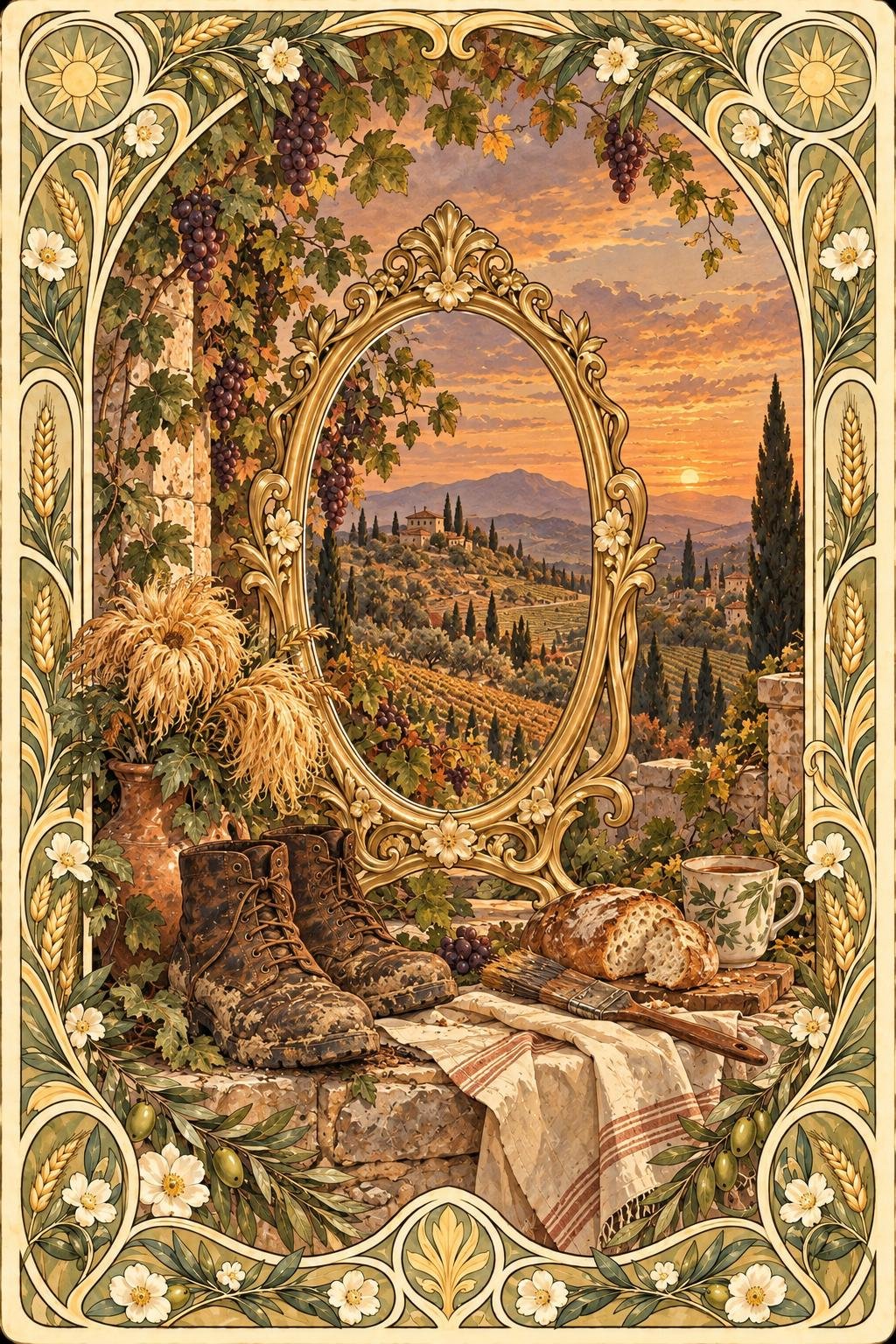
The woman in the card once met the lion with open palms, her quiet touch resting on the beast’s jaw. Now her grip tightens. Her knuckles strain as if she must prove her command. The lion’s breath grows shallow, and the space between human and animal becomes less trust, more contest. In the hush after, there is the sense of struggle echoing through more than flesh: a reminder of resistance in all things forced past their nature.
On the slopes of Tuscany, the ground is thick with a particular earth. For centuries, hands have driven spades into this soil, scraping out the compacted clay beneath olive trees and sun-bleached stone, drawing up the weighty clods that artisans, alchemists, and painters once called by the name of an old city. Through the narrow streets of that city, mules once carried sacks laden with the earth, destined for the workshops where it would be heated, ground, sifted, and stored in jars. Each jar was something both simple and exacting: a promise of color and permanence for the walls of chapels, the robes of saints, the coats of harlequins. The pigment was both humble and prized, an offering from the land that demanded careful work, fire and patience, to reveal its heart.
People built with this earth, too. Bricks shaped from the same clay were stacked into arches and towers, their surfaces roughened by centuries of rain and hand. In kitchens, mortars carved from fired clay ground pepper and salt, grinding out small acts of preparation for daily bread. There was always a sense that this earth was not just underfoot, but part of the body’s labor—the press of a palm into dough, the shaping of tiles for a roof, the thick rim of a jug raised to thirsty lips.
Sometimes, the sky over the city would fill with a storm that coated windowsills and courtyards with a fine, powdery dust. On these days, the air pressed down, heavy and close, the kind of weather that makes a person long to open every shutter and door. But often, the first response was the opposite: to seal the house and brace against the grit, to sweep ever more furiously against the gathering film. The more the dust was scrubbed, the greater the sense of futility—until, in the late afternoon hush, someone would relent and step outside, hands falling open at their sides, simply breathing in the scent of earthen rain.
In the long history of the pigment trade, merchants haggled and jealously guarded their sources. Some forged certificates, passing off impostors dug from lesser hills, and arguments flared in the dim-lit back rooms of apothecaries. Over time, the city’s name became shorthand for a standard of steadfastness, a mark of what endures when all else is scoured away. But always, the substance itself had to be coaxed, not coerced—driven too hard, it would crumble or cloud, never yielding its depth.
Today, a person might choose to set their hands in cool clay, or knead a loaf of bread with slow determination. They could sweep the floor and then pause, letting the last traces of dust settle where they will. A small, lidded jar on a shelf could be opened and admired for what it holds, and then closed gently, with respect for what patience brings forth.
Today's lucky color is Sienna.
Lucky Color: Sienna — #A0522DPatience and persistence grow deepest roots in yielding ground.
Let force turn to care, and watch what endures.