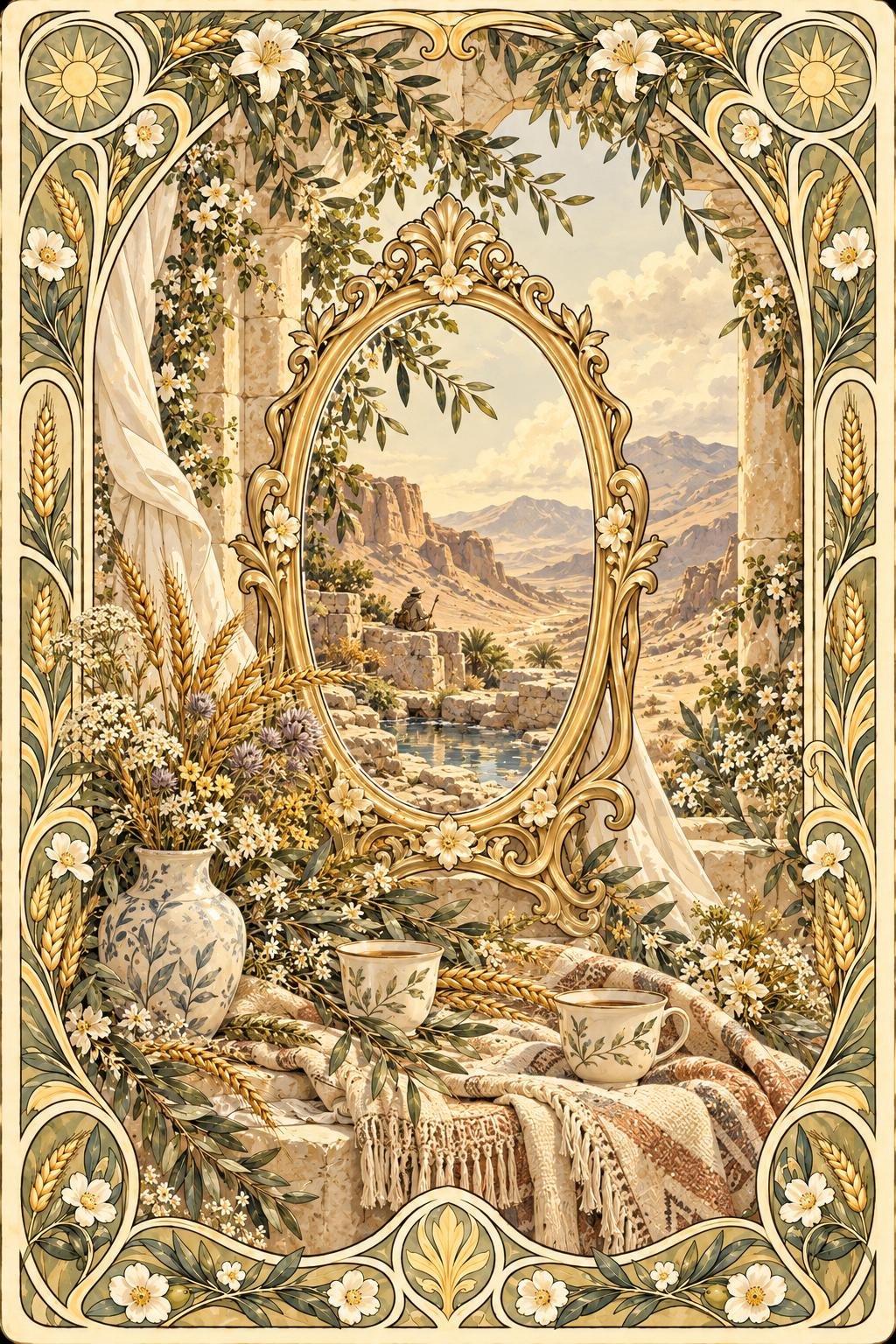
The card shows an angel pouring water from one vessel to another, standing with one foot in the shallow pool and one foot on dry land. The work is slow, each drop shifting from cup to cup, a careful act of balance. On the horizon, a narrow path winds toward the distant ridge of mountains, promising a journey that asks for patience and a steady hand. Each element—vessel, water, ground, and path—brings to mind the spaces where quiet blending occurs, spaces where subtlety matters more than spectacle.
In old kitchens, flour sacks hang on wooden pegs, their fabric soft from years of use. The sacks are sturdy and plain, bearing the marks of grain milled in distant fields and carried across miles. Within a farmhouse, such sacks are opened by hands familiar with breadmaking, the flour sifted into bowls, mixed with water from the well, and left to rise under a linen cloth. The cloth, woven by women whose fingers knew the rhythm of the loom, is light against the dough, a shield from dust and eager insects. In these kitchens, daily labor settles into a gentle ritual: measuring, pouring, kneading, resting. There is comfort in repetition, and in the hush between tasks, the bread dough transforms. The transformation is not loud or sudden, but sure.
Beyond the farmhouse door, the day may be one of low sunlight and mild air. In open fields, sheep graze and ruminate, their coats thick and unhurried. The air carries the scent of harvested wheat and the distant sound of a stream moving over smooth stones. On such days, the weather is neither harsh nor sharp; there is a sense of quiet sufficiency, with clouds stretching thin and the sky offering a gentle, even light. This is the weather that invites people outdoors, to sit on a woven mat, to shell peas or thread beans for supper, or simply to watch clouds drift. The moment asks for nothing extravagant—just presence and the willingness to mix the inner with the outer world, as the angel mixes water.
Elsewhere, in the storeroom, rows of sacks rest beside baskets of potatoes and onions. There are ropes of garlic, and bundles of dried herbs tied with twine. The flour sacks, again, become a line of defense against hunger, a promise that bread and sustenance are never far away. In villages, merchants once traded these sacks for eggs, or a length of homespun wool, their hands exchanging what was plain yet essential. The sackcloth would later be repurposed: sewn into aprons, dusters, or pockets for a child’s jacket. The fabric lingers, carrying with it the scent of grain and work, and the memory of hands that pressed and folded, always seeking to combine what one has with what one needs.
At the edge of cultivated land, a path worn by footsteps leads over gentle rises, skirting fields and threading between tufts of dry grass. Here, a traveler might pause to eat a crust of bread, wrapping the loaf once more in the familiar fabric before walking on. The journey is humble, but the path is sure, marked by the quiet determination of those who came before. It is a landscape of patient change, of finding harmony by mixing, of trusting the ordinary to yield something durable.
Today, a person may lay out a flour sack cloth as a table cover for tea, or use it to wrap freshly baked bread. One might smooth the fabric over a pillow and rest in the afternoon, or walk beneath a sky whose light feels soft against the skin. To practice mixing is to find balance in daily things: to combine, to blend, to rest, and to journey.
Today's lucky color is Beige.
Lucky Color: Beige — #F5F5DCQuiet work and gentle weather bring the day into balance.
Small acts of combination invite harmony.