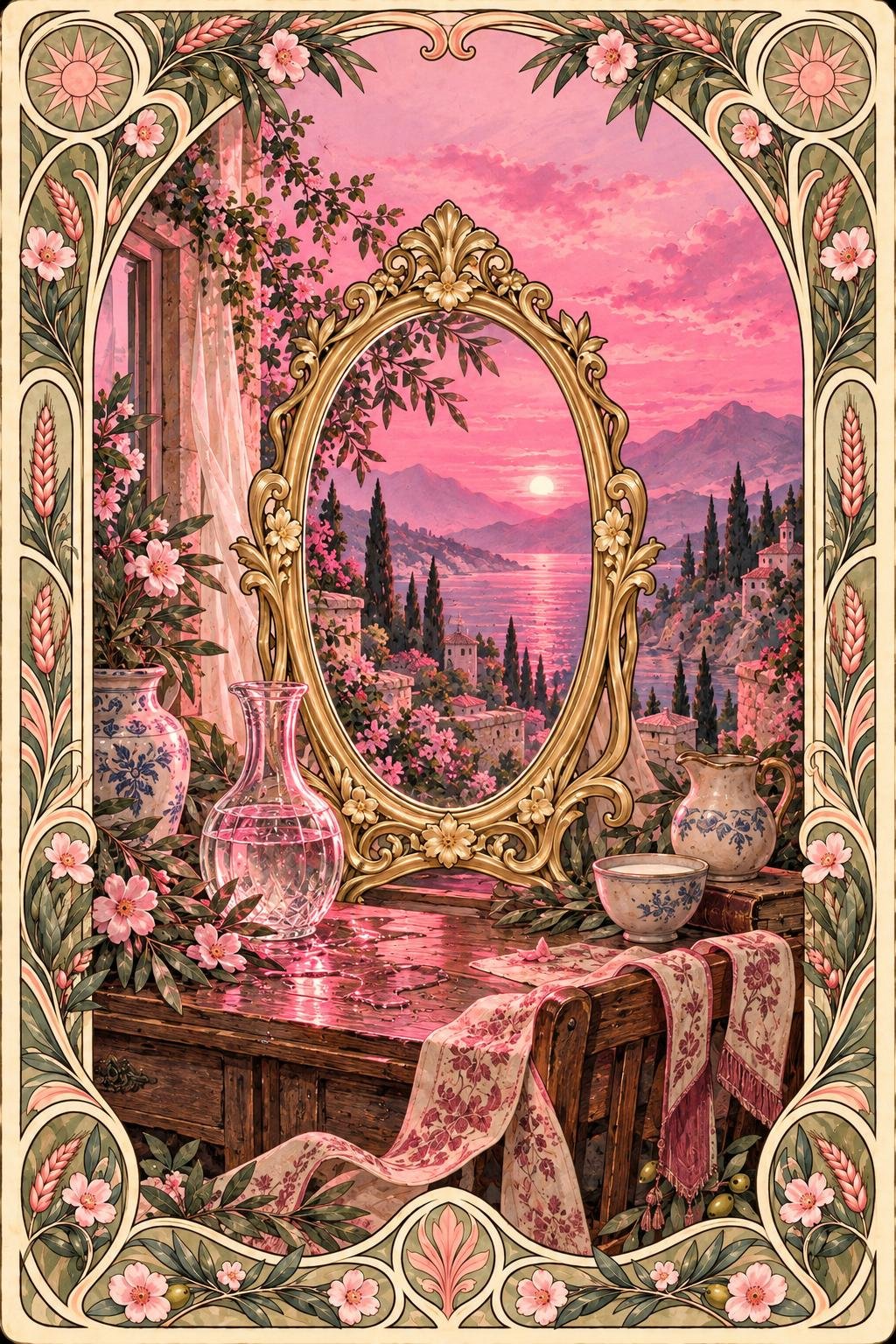
In the reversed Temperance, the angel’s careful hands tremble, and the water, meant to flow in perfect arc from one vessel to another, spills across the table. The delicate ritual of mixing falters. To one side, the liquid pools, soaking the cloth beneath, a sign that not everything finds its place in time. The harmony that once held two elements together now tips, and the commonplace tools of balance—measuring jug, handled bowl, and steady cup—are left scattered, their purpose stalled. The moment is overripe, like fruit left too long on the vine, sweetness threatening to slip into cloying excess. One side is heavy, the other light, and the fulcrum lost.
In the history of marketplaces, traders would once weigh their goods on carved wooden scales, always attentive to the evenness, but sometimes a careless thumb would tilt the measure, and the heap of peonies—cut with morning dew still clinging to their ruffled heads—would tumble to the ground, bruised and brilliant. Petals would scatter across the cobblestones, crushed beneath hurried feet, their scent rising sharp and sudden. The piles of camellia blossoms, gathered from shaded gardens, never quite made it to the next basket, and tea brewed from such flowers would taste slightly askew, as if the weather itself had pressed its own desire into every cup.
There are places where the landscape remembers imbalance. In the southern reaches of the Andes, the slopes are scattered with wild cactus and the blooms that appear after a sudden rain. These flowers burst open after months of drought, their presence a rush rather than a gentle unfolding. The air, heavy with humidity, drips from washed walls and seeps into the woven hammocks hung beneath veranda roofs. Here, the arrival of a monsoon can tip the season toward chaos—rivers spill over, and blankets embroidered with carnation threads are pulled tightly around shoulders as the night cools too fast for comfort.
Stories in old myth tell of the goddess whose robes trailed behind her as she crossed the threshold of dawn, brushing the petals of roses grown in the shadow of marble columns. The silk of her dress—dyed in the old way, with cochineal ground on stone—was a rare prize, made only by patient hands and only for the highest celebration. Her attendants, carrying amphorae, were cautioned to step carefully or risk splashing the precious wine. At every festival, someone would laugh too hard, jostle a jug, and the drink would spill, staining the mosaic floor, leaving a mark that lingered far longer than the laughter.
In a quiet kitchen this morning, a child may place a single carnation into a glass jar, the stem trimmed unevenly, the flower nodding under its own fullness. Someone, seeking equilibrium, stirs raspberry preserves into yogurt, watching the swirls refuse to blend, each streak a testament to the moment before mixing is complete. A traveler, pausing at a market, selects a Turkish delight from the tray, powdered with sugar, savoring the stickiness that clings to their fingers. A seamstress, mending a silk scarf, threads her needle and runs it through the petal-embroidered edge, recalling the times when the fabric once fluttered in festival air. Each of these gestures offers a way to honor the beauty of what spills over, to embrace what refuses to settle quietly into the cup.
Today's lucky color is DeepPink.
Lucky Color: DeepPink — #FF1493Let imbalance become a beginning, not a wound.
Every spill marks a turning.