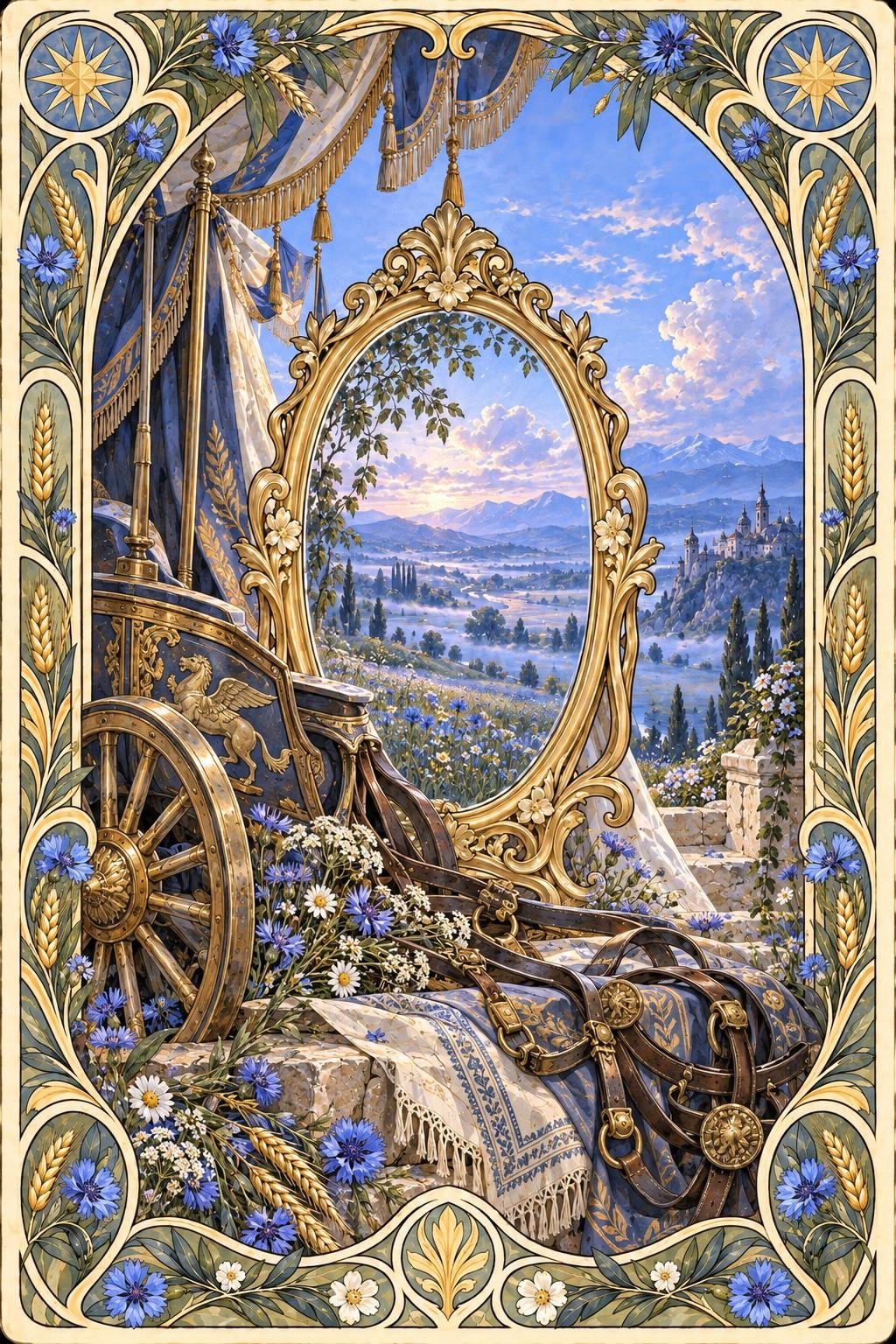
A canopy stretches overhead, tethered to posts at the back of a moving chariot. Its fabric is woven from the same threads once used for summer aprons in the high fields of Europe, where wildflowers thrive between the furrows of wheat. In the center, two beasts strain at their harnesses, their momentum decisive only when the driver’s hands keep both lines tight and equal. The city gate looms ahead, lintel carved with old stories, its stones touched by the same cool breeze that once swept over the open hills near the borders of France and Germany, where the fields in June become a scattered sea of cornflowers.
The story of this orientation is one of harnessed drive. The charioteer is not carried by the beasts alone, nor by the momentum of the wheels, but by the discipline of keeping the reins taut and even. The canopy above him is more than shelter; it is a reminder of fields far beyond the city, where every June brings a quiet festival of small, radiant petals. In these fields, women have gathered cornflowers for centuries, tucking them behind ears or threading them into garlands for local processions, their hands stained and fragrant. The flowers are stubborn, growing wild on the edges of plots where farmers labor for bread, refusing to be tamed or plucked away by the logic of plow and blade.
There is myth in these blooms. It is said that when gods wished to walk unseen, they would hide among the cornflowers, bending low between their slender stalks, shielded from mortal eyes by a natural canopy. Medieval healers gathered the flowers at dawn, believing that infusions brewed from their petals would clear the vision and sharpen resolve. In some places, the petals were pressed between the pages of prayer books or stitched into the hems of children's clothing, offering unseen protection at the threshold of the world—city gates, village squares, the edges of wild and cultivated land.
The journey of the charioteer is not only through gates of stone, but also through weather and season. On mornings when the sky is swept clean after a night’s rain, the light over the fields seems to shimmer, promising clarity and the sharp focus needed to guide two divergent forces forward. On such days, a traveler might find a handful of cornflowers left on a doorstep, or notice them twined around the handle of a water pail, a quiet sign of hope and persistent motion.
Today, one can echo the movement of the chariot in simple ways. Carry a wildflower tucked into a jacket pocket as you walk through city streets, a small reminder to keep hands steady on the reins of daily ambition. Brew a cup of tea with dried cornflower petals, letting the scent recall open fields and distant horizons. Find an old linen cloth, its weave echoing the canopy above the chariot, and use it to wrap a loaf of bread for a journey or a visit. Open a window after rain and let the air move through, as if clearing a path toward something just beyond the familiar.
Today's lucky color is CornflowerBlue.
Lucky Color: CornflowerBlue — #6495EDForward momentum comes when you pair what is wild with what is disciplined.
The city gate opens when you remember the fields beyond it.