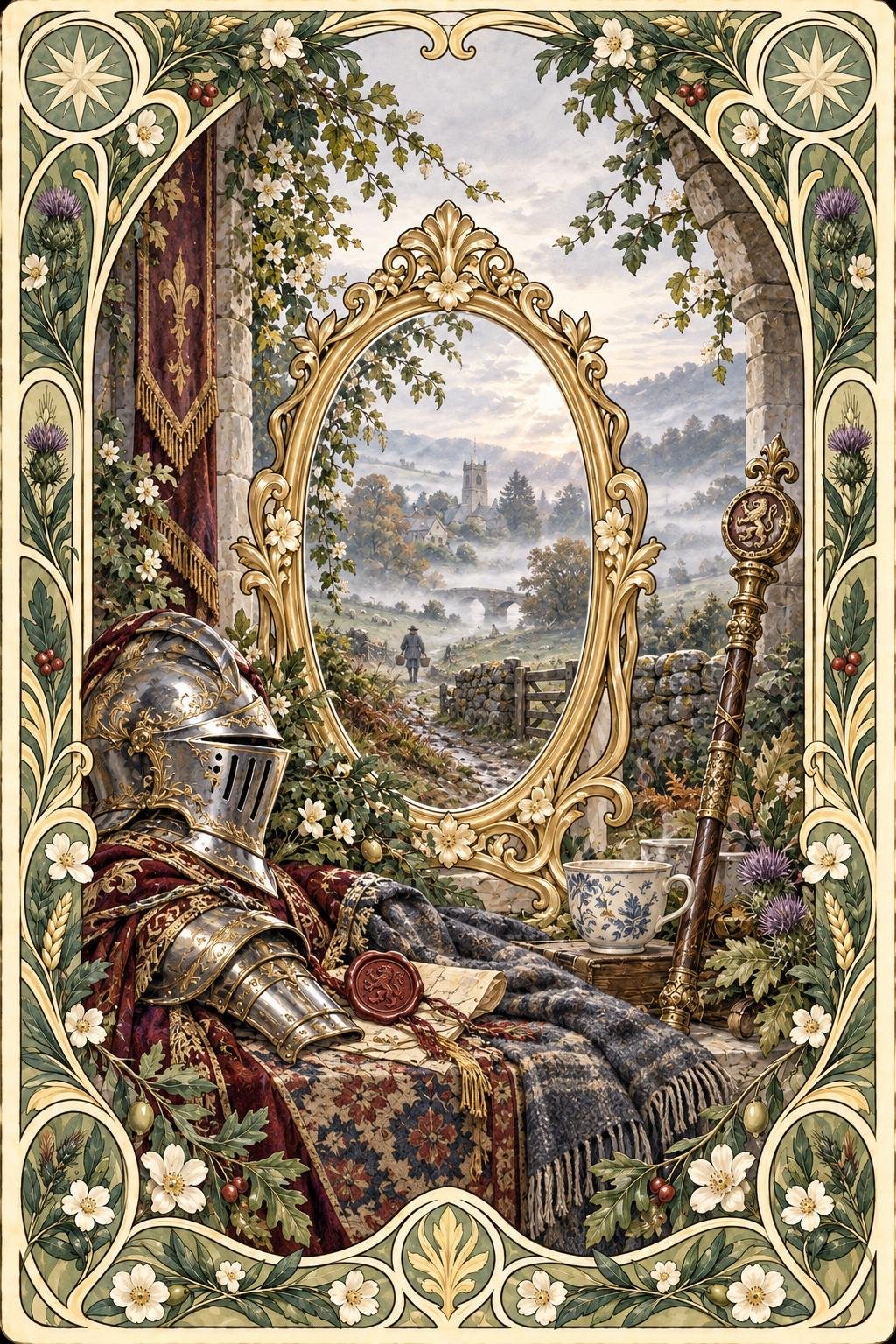
The throne stands motionless in a sunlit room, its tall back carved with feathered wings and lion heads, but the figure who should command it is absent. Only order lingers—the precise pattern of the marble tiles, the iron lines of the window grilles, the starched linen cloth draped over the armchair, awaiting a guest who will not arrive. Power has left its traces in discipline alone: the exact folding of a napkin, the click of heels across the corridor, the annual documents bound with silk string and set in flawless ranks upon the shelf. The space breathes the memory of authority, yet the warmth of its presence has faded, leaving rigid protocol in its place.
Beyond the windows, the city’s rooftops dissolve beneath a sky hung with the fine haze that signals a turning of the seasons. The morning after a rainstorm, chimneys awaken with signals of their own—the delicate plume that rises when a baker lights the first oven, when a smith kindles the forge, when a grandmother stirs laundry in a copper pot behind her house. In the square, pigeons pick through crumbs left on the church steps, and soft vapor drifts from the mouths of early risers as they wait for their bread. Once, in the old world’s ceremonies, banners unfurled to mark the crowning of a ruler, and all eyes watched for the gentle cloud that emerged when a conclave reached its verdict, a proof that something sacred had passed.
In the hills outside the city, shepherds gather before dawn, rubbing their hands for warmth and watching their breath mingle with the mist curling above the river. Sheep graze in small bands, their coats thick and tangled from winter storms. A kettle whistles over an open fire, its spout wrapped in gauze to filter every impurity from the water. The rites of daily life are preserved in these small rituals: the pressing of curds in muslin, the spreading of soft cheese upon a fresh slice of bread, the washing of faces with a square of cotton kept aside for Sundays. Each gesture is precise, as if discipline itself could hold the world together when the figure of command has vanished.
Inside homes, the mark of order lingers in the careful laying of tablecloths before a meal and the folding of curtains at dusk. A faint trace rises from a steaming bowl of rice or a newly boiled egg. Elders tell stories of distant lands where slow clouds rolled in from the sea and settled over port cities, hiding the ships at anchor and making the streets unfamiliar. The old merchant in the corner shop recalls the days when new shipments arrived wrapped in tissue, each layer peeled away to reveal treasures—porcelain, embroidery, spices—guarded by soft, clinging fibers. Now, only the act of unwrapping remains, an echo of ceremony.
In weather, the forecast brings word of days when fog descends quietly, blanketing fields and hedgerows, and every outline softens. Children press their hands to the window, watching the world turn featureless and distant. It is the hush after the loudest storm, the quiet before the city stirs, the gentle veil that settles after upheaval, promising nothing but a chance to begin again with patience and care. So too, the seat of power sits empty, but its procedures continue, upheld not by a single will, but by the smallest, most enduring acts of attention.
Today you might air out the linens at dawn, fold your towels as if they were heirlooms, or wrap a loaf of bread in clean muslin before breaking it with others. You could pause to watch the drift above a chimney, or listen for the softest whistle of a kettle in the morning.
Today's lucky color is WhiteSmoke.
Lucky Color: WhiteSmoke — #F5F5F5A new day’s discipline rests in quiet hands.
Silence carries the old forms forward.