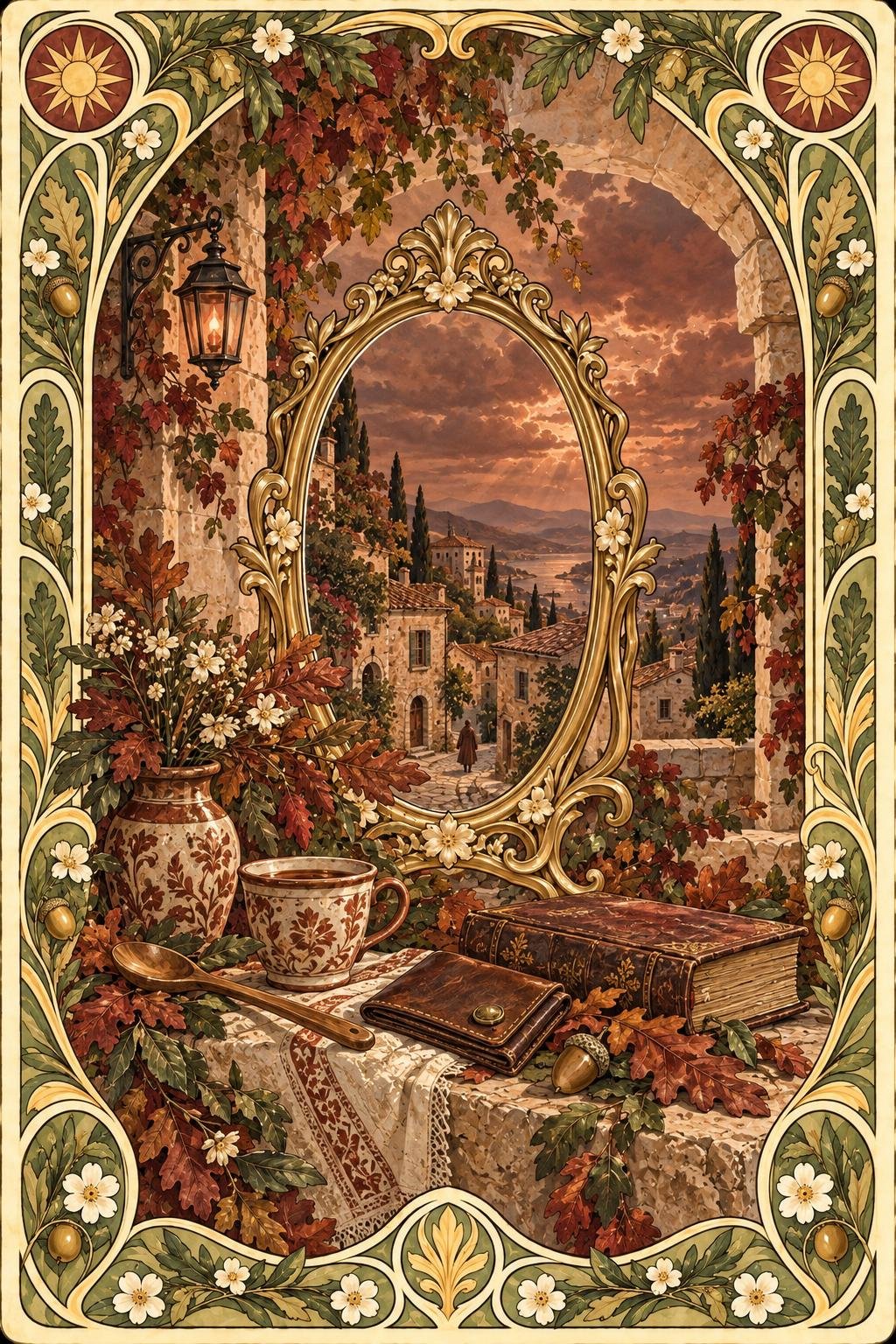
The Hanged Man is the suspended figure, an image slowed far beyond stillness, where movement is an idea, not an act. Upright, the card asks for surrender. But reversed, it captures the moment after: when time itself has paused, but the mind cannot accept the pause. What follows is not rest, but agitation—an urge to move, to resume, to push against the very knots that bind the ankles.
The world that waits at the end of such resistance is not an airy summit or a bright meadow. It is the ground, silent after harvest, thick with last year’s stalks and the memory of rain. The farmer walks the fields after the plow, boots heavy with earth, the season’s labor paused not because of completion, but because the world itself has said “stop.” Yet eyes scan the furrows, hands twitch for the missing shovel, refusing stillness as if it were an accusation.
History is written in these furrows. Old roads running through the countryside, pressed flat by countless wagon wheels, always seem to go somewhere, even when they end at a locked gate or a tangled hedge. There is the urge to keep traveling, to keep carrying burdens—sacks of coffee beans, crates of nuts, bundles of tobacco leaves—long after the journey has been declared over for the day. At the crossroads, the signposts are weathered wood, carved by hands that could not bear to stand idle, each pointing to another town, another task. Even the inn’s table, polished by generations of resting elbows, holds the stain of old spilled tea, a mark that never quite leaves and never quite means the same thing twice.
In the old stories, there is the tale of the stubborn ox, refusing to turn away from the yoke even when the plowing is done, standing hip-deep in straw, waiting for a command that will not come. There is the tale of the miller’s apprentice, dusted head to toe in husks, rising before dawn to tend the grinding stones, unable to sleep for fear the morning will arrive before the grain is ready. In myths, the unyielding moment is not always a triumph; it is sometimes a refusal to be transformed, to trust the fallow season, to see meaning in the waiting.
To walk through this landscape, one presses a palm to the tabletop and feels the grain, or digs bare fingers into the cooled loam of a garden bed. A kitchen drawer opens to reveal the wooden spoon, worn oblong by a thousand soups, or the rolling pin that once shaped dough into rough rounds for a midday meal. In the corner stands the broom, bristles dulled by use, each sweep across the floor a small insistence on order. In a distant city, the weather turns, and the wind brings the smell of fallen leaves and the promise of rain-soaked soil. The air inside tastes of baked bread, of chestnuts roasting at a corner stall, of coffee brewed strong and left to cool beside a stack of old ledgers.
Today, returning to the daily grindstone can bring comfort: kneading dough with both hands, tracing the ridges of a walnut shell, sanding a rough edge from the seat of a chair, or turning over compost in a quiet corner of the yard. Each action accepts the world’s pause by making meaning out of what is halted, out of the tools and harvests that remain close at hand.
Today's lucky color is Brown.
Lucky Color: Brown — #A52A2ALet the scent of earth and wood guide your patience.
Pause, and see what endures when the journey slows.