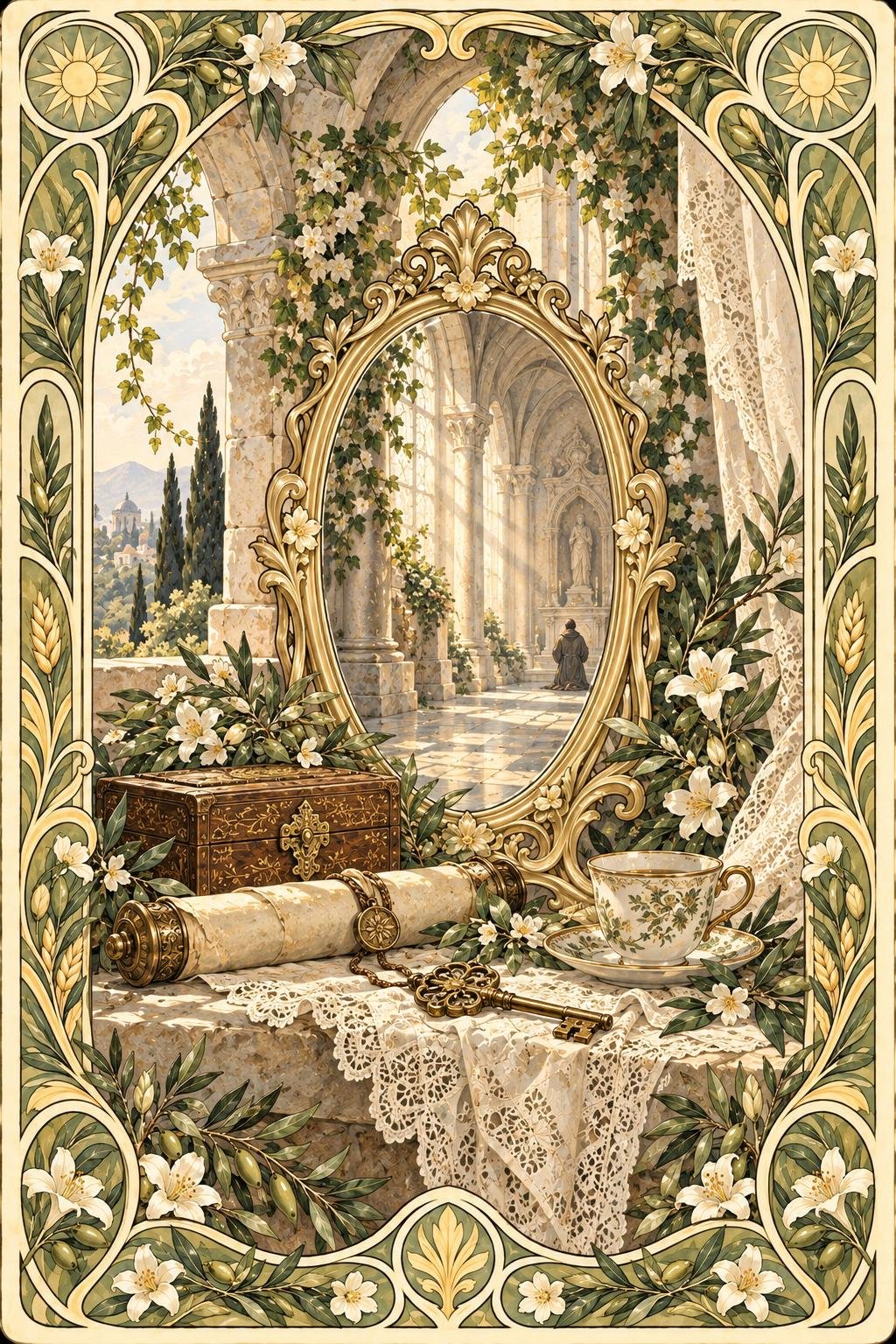
The great hall is hushed beneath its arched ceiling. Keys glint from a ring held aloft, vestments trail down marble steps, and the hush is broken only by the soft shuffle of slippers and the muffled cough of two quiet attendants. The ritual is old, older than any living memory, and it is housed in the architecture of discipline: pillars carved, mosaics in the floor, the echo of rules within every stone. In this temple, the code is inherited, not invented. The Hierophant presides with the gravity of centuries, directing the flow of tradition through the daily ceremony.
Among the sacred objects, there is a cloth, delicate and storied. It is a fine mesh, its pattern laboriously looped by hands who learned from those before them, and then passed on their skill, knot by knot. This cloth, once used to veil the faces of matrons or to shroud the altar, whispers of afternoons spent in quiet rooms: a wooden bobbin clicking against the ring finger, a slow spiral of thread unwinding in a circle of light. In grand houses, it adorned the edges of linen, a mark of refinement; in village chapels, it was used to bind the old missals, cushioning the corners of dog-eared pages. Lace, once traded across borders, once taxed by kings, flows through history as thin as breath and as enduring as prayer.
This threadwork carries within it the footsteps of generations: brides fingering it nervously before stepping into the nave; a child counting the loops to learn patience; a widow folding it into her drawer. It is a language without words, a symbol on the table at feasts and vigils alike. To handle it is to participate in the ritual of care, to acknowledge that beauty can be patient and that patience can be beautiful. In the hands of the Hierophant, it becomes a garment of office, the border that separates sacred from mundane, mentor from seeker.
In certain regions, the craft found its home in damp, foggy towns where the sea’s chill necessitated long evenings by the fire. There, the weather pressed in on stone cottages, and the only thing to do was to wind the thread and listen to stories. The lace became more than decoration; it was a record of survival, of keeping hands occupied through the slow seasons, of community stitched together by delicate labor. Later, in smoky city drawing rooms, it was a mark of aspiration—ladies and gentlemen set fine cloths beneath their tea cups, displaying their taste and their adherence to custom. Shops with narrow windows displayed bundles of this fabric, and markets echoed with the calls of traders.
Today, you may find some of this inheritance in the bottom drawer of a desk, or folded in a hope chest, or still gracing the edge of a family altar. To honor this, you might take time to mend something by hand, to write a note of thanks on stationery edged with delicate patterns, or to sit in a quiet room and recall the stories wrapped in your own household linens. If you have the opportunity, pass along a skill—fold a napkin with care, teach a child to tie a bow, or simply share a memory that threads the past to the present.
Today's lucky color is OldLace.
Lucky Color: OldLace — #FDF5E6Carry tradition quietly, and the path will be gently lit.