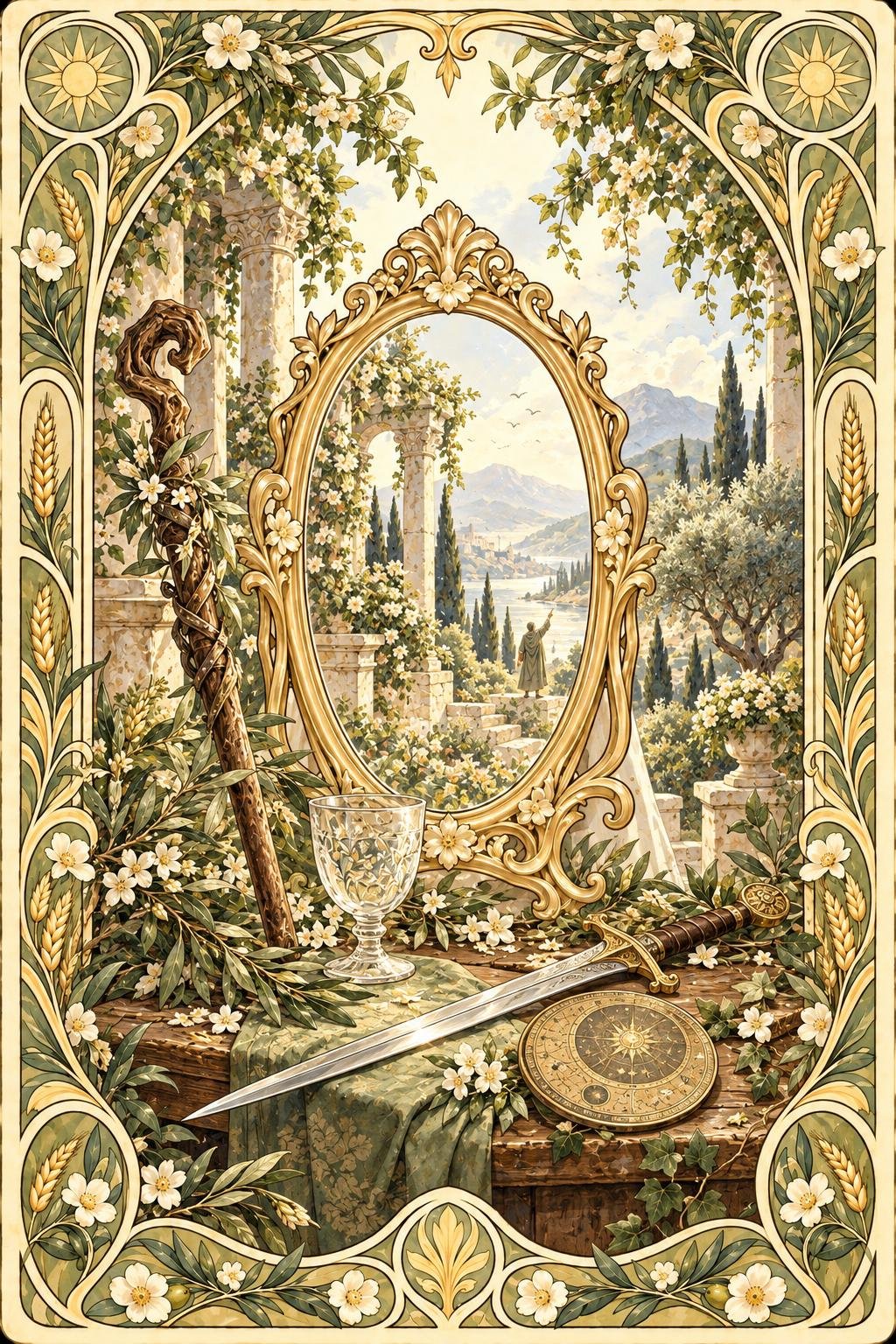
On the table before the Magician, four implements rest: a wand cut from olive, a chalice of pale bone, a blade with a hilt made from the tusk of a creature long vanished from the plains, and a disc pressed from ancient metal. Each tool speaks to an element, yet the one that gleams softest is the chalice, carved with the patience of centuries, its surface smoothed by many hands over many generations. This is not a cup of glass or clay, but of an old substance that carries the memory of creatures who once traversed the vast river deltas beneath cloudless skies.
Above the Magician’s head, the looping band of infinity glows like a horizon far in the desert when the sun has just climbed. The table stands at the edge of a tended garden, where lilies open at dawn, their petals reflecting the first gentle light. Here, the wand points upward, drawing in the promise of clear weather, when mist lingers before the warmth rises. The Magician’s other hand reaches downward, grounding the force in soil, in the roots of flowering bulbs and in the promise of what is yet to grow.
Throughout history, the material that shapes the chalice and the blade’s hilt has journeyed from the heart of forests and from the farthest savannas, carried by merchants along winding rivers to cities of marble and incense. In the time of ancient empires, it was said to be more precious than rare spice, passed from palm to palm as tribute, or carved into keys for sacred doors. The Magician remembers such things, how an artisan in a river port once pressed leaf patterns into the surface, so that it would catch the candlelight in quiet rooms where secrets were spoken. Deep in the archives of old monasteries, scribes have kept dice and chessmen made from that same smooth substance, their surfaces worn by the touch of generations.
Myth tells of a palace built on a cliff overlooking the endless dunes. There, a throne was fashioned not from stone, but from the same material as the Magician’s chalice—a monument to the power of will and the mastery of craft. At the foot of that throne, minstrels would play pipes and clappers carved to a fine polish, their notes echoing on clear morning air as if calling down wisdom from above.
In the kitchen, a mortar and pestle shaped from that same origin crushes seeds and grains, mixing the earthy scent of harvest with the memory of elephants and of great forests. In the cloth chest, a comb with narrow teeth, carved smooth, is passed from parent to child with blessings for skillful hands and gentle hearts. Even in winter, when the wind wraps the house and the hearth glows, a set of dominos, their faces dotted and familiar, rests on the mantle—each piece carrying the density of distant landscapes and the patience of ancient hands.
Today, a person can hold a keepsake shaped from these origins, tracing its lines and remembering the journey of old stories. They may brew tea in a cup that echoes the Magician’s chalice, savoring a moment of intention before speaking. They could carve a simple shape from soap or soft wood, honoring the craft that bridges memory and will. Or they might open a well-loved game, feeling the weight and coolness of each piece, and invite quiet luck into the room.
Today's lucky color is Ivory.
Lucky Color: Ivory — #FFFFF0Let will become form. Every tool you need is already within reach.