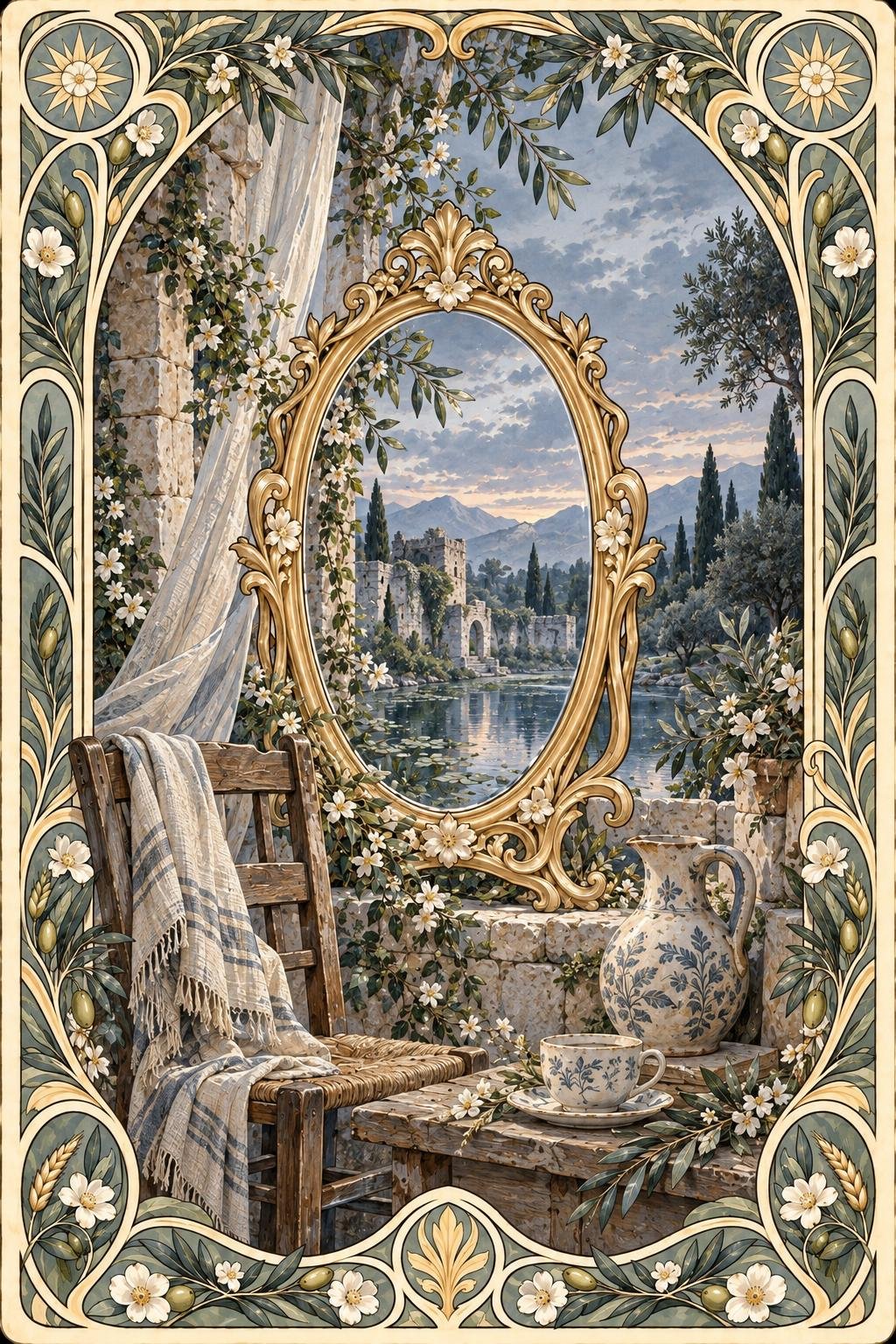
On the border where water once met the dry shore, a pair of pitchers rests, their insides empty, their mouths still open to the sky. The stars above remain, distant and unchanged, but the pool below is receding, the ground around it marked by fine, flat stones. The air is thin and the grass has drawn back. A hush holds the edge, and the land keeps the memory of the stream that paused here—its last, thin sheet drying into the earth.
Not far from such a pond, in the uplands or the folds of old hills, lie the homes of quarrymen, their work written in the ridged tablets stacked by the roadside. These stones have been split from the earth’s deep layers, carried to build hearths and thresholds, to make strong the floor beneath foot and the roof above rest. Their faces hold the day’s light or the evening’s fog, and under a certain sky, they seem to drink in the hush, storing it for the slow hours. To pass a finger along the edge of one of these split stones is to remember waiting, endurance, and the patience that shapes raw land into shelter.
Travelers once crossed mountains where these stones lay scattered, following the ridgelines through long, cool dawns. They would hear the wind pull over moor and fell, see the weather gather—clouds pressing low, the air so quiet that even the sheep and the wind-bent grass seemed to hold their breath. Out on the open stretches, a mist might settle, wrapping everything in a faint, fine dust. Those who knew the way would watch for a certain stillness, the kind that signaled not danger, but pause: the world drawing in before the next event, the ground itself holding the memory of rains and clear nights.
In old towns, roofs made from the same hard stone slope together against the elements. Their surfaces channel the rain, their edges shelter the eaves. Cottages knit together under these sturdy covers, their hearths glowing in the dusk. At the hearthside, an old kettle is set, its sides dulled by time and quiet use. The hands that tend it move slowly, careful not to spill, each motion a lesson in how to endure a season of drought or pause. On the mantle, a flagstone carved with names stands witness to the generations who have carried water, who have known both the giving and the taking away.
Even in the city, these quarried stones make their mark: steps worn smooth by countless shoes, benches in the public square, the sills of old libraries. They stand, solid, whether the day brings drizzle or dust, whether the square is crowded or empty. Their presence is unshowy, enduring, holding the memory of all the weather that has passed over them. When the night is clear, and the city quiets, the stones seem to gather the distant gleam of the stars above, echoing their patience.
Today, someone might sweep the dust from their threshold, letting hands recall the slow, simple labor of those before. They can bring in a piece of slate to anchor papers or rest a cup, or set a kettle on the hob and wait for water to warm. Pausing by a stone bench or quiet rooftop, there is space to remember the hush at the pool’s edge, and the patience needed when the water draws away.
Today's lucky color is LightSlateGray.
Lucky Color: LightSlateGray — #778899Endure the pause; the stars are always above.
The stone’s memory is quiet and long.