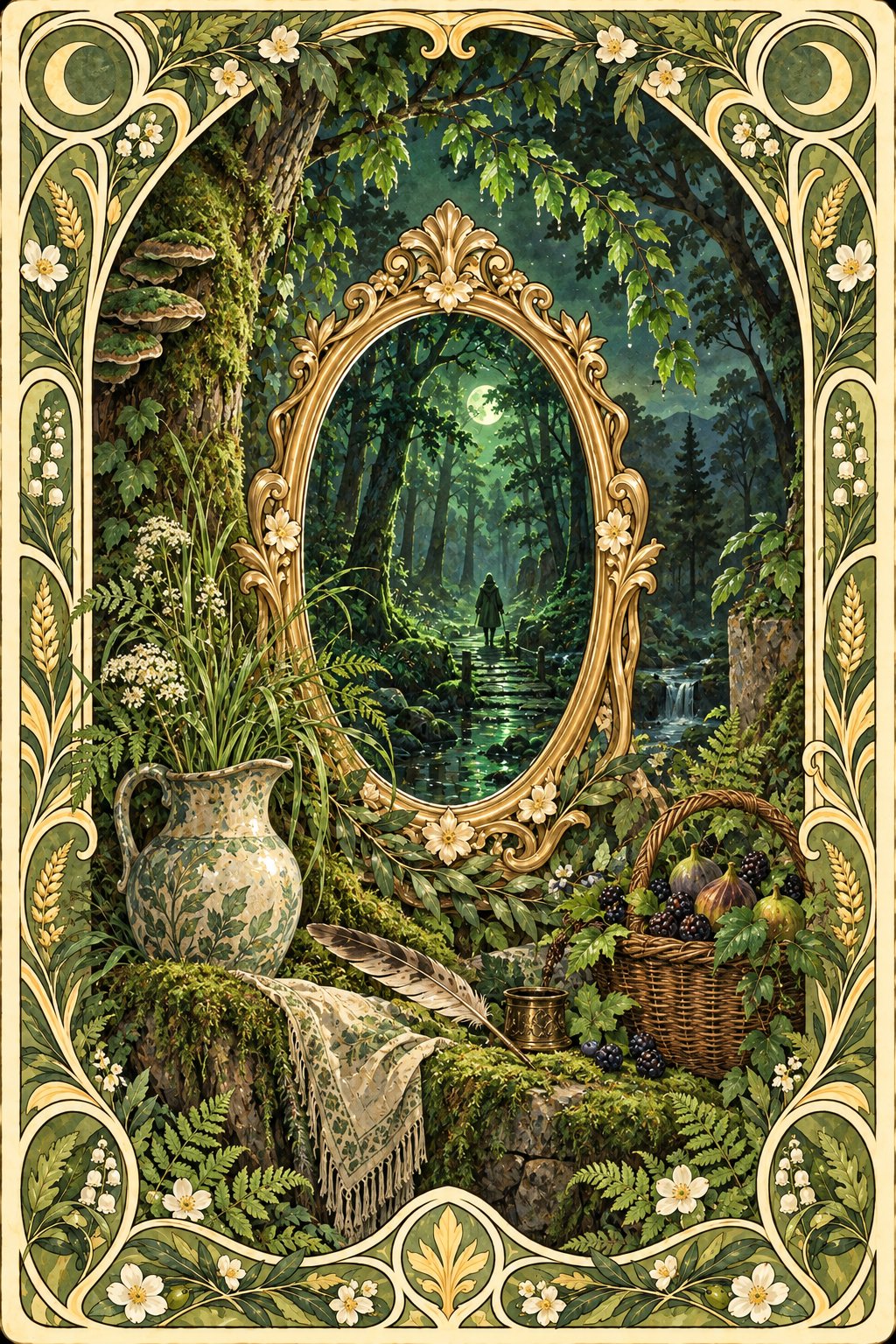
A wreath of leaves encircles the dancing figure, her step light and sure, the ribbon at her waist tying one circuit closed as four living creatures stand at the corners, steady and attentive. The card’s boundary is not a wall but a living border, a passage marked by branches and the quiet rhythm of completion. Here, the world is present in the hush of ancient woods, where endings give birth to beginnings, and all things are woven together by time and growth.
In the heart of the world’s forests, the air is cool and rich with the scent of resin and damp loam. Tall trunks rise in ancient cathedrals, their crowns joined overhead to form a sheltering roof that lets in mottled sunlight. In the old European woodlands, hunters and foragers moved carefully, picking mushrooms by the roots of beech and oak, and gathering wild garlic at daybreak. Farther east, monks in Russian hermitages read their prayers beside thick stands of spruce, their robes brushing against ferns that curled around fallen logs. In North America, broadleaf trees and evergreens knit together in the Appalachian stretches, their shadows home to foxes and deer, and to stories passed from one generation to the next about the wisdom that lives at the forest’s center.
These woods have shaped myth and custom. In ancient Greece, laurel branches crowned the victors, the living sign of journeys completed and honors won. Shepherds and villagers from the Carpathians to the Alps have long gathered herbs and boughs, weaving them into circles at festival time to mark the closing of one year and the opening of the next. In West Africa, beneath the shelter of towering giants, families gather kola nuts and wild yams, the gifts of a land that renews itself each rainy season. In Japan, the forest is a silent companion: cedar groves surround shrines, and local people tie paper prayers to twigs, trusting the spirits that dwell within the ancient shade.
Trade and craft have always followed the forest’s quiet order. Woodcutters shaped beams for temples and homes, while herbalists dried fronds and cones for healing teas. In the workshops of Scandinavia, carvers made bowls and spoons from the fallen limbs of birch and alder, honoring the patience of growth. In homes from the Scottish Highlands to the Balkans, people simmered wild greens for a simple meal, or hung branches of fir above the door for luck and renewal.
The weather within these groves is a world in itself. After rain, the ground glistens and each leaf holds a trembling drop. In spring, sap rises and the understory hums with busy insects, while autumn brings a slow drift of needles and soft, fragrant litter that cushions every step. Winter hushes the canopy, but life waits beneath, ready to begin again as soon as the thaw comes. The ribbon is never truly tied off; it is looped for the next season, the next dance.
Today, a person can step quietly beneath high branches in a nearby park, or gather a handful of herb sprigs to place in a bowl on the kitchen table. One could prepare a simple meal using wild greens, or weave a ring of fresh boughs to hang above the door as a marker of renewal. In these ways, the world’s circuit is honored, and the quiet strength of the woods comes home.
Today's lucky color is ForestGreen.
Lucky Color: ForestGreen — #228B22Let the spirit of the deep woods guide you onward.
Carry the peace of ancient groves close to your heart.