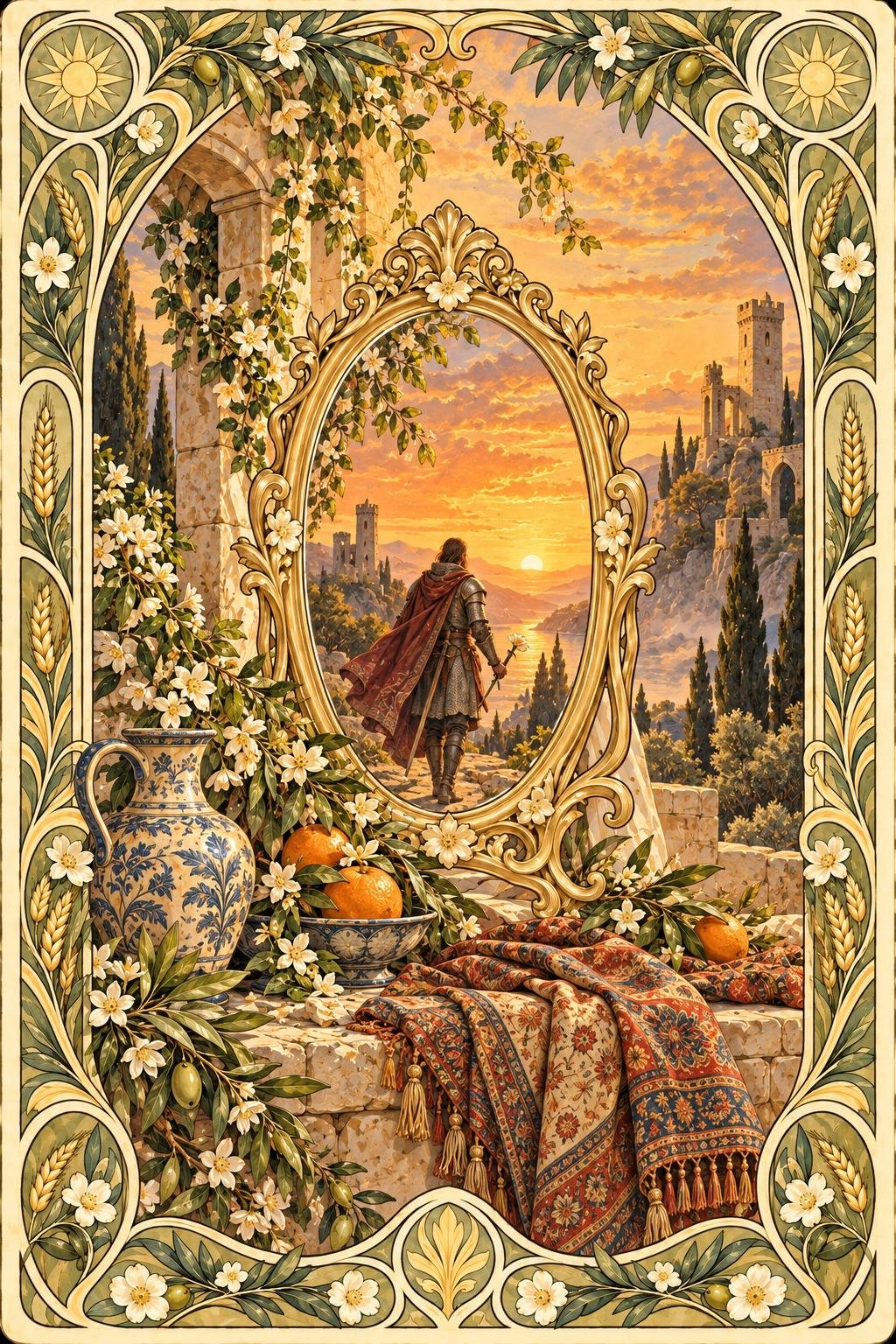
The rider moves forward, his gloved hand holding a single bloom, pale as the light breaking between two distant towers. The air is chill, unsettled, as if all things wait for a message that will change what they know. Behind him, the town stirs: roofs glint with dew, gates creak open to the sound of hoofbeats. The land feels suspended at the edge of night, where the old shape of life is dissolving, and something new, unnamed, begins to form in the hush.
From the East, the day arrives, first as a rumor, then as the glow that creeps over groves and rivers. Here is a fruit in heavy clusters, its rind marked by old trade routes and the hands of those who carried it through spice-laden harbors. In fables, a princess once peeled this fruit and the scent filled a silent room, signaling the end of sorrow. Its flesh, sectioned and sweet, is what travelers share at crossings and what children clutch on festival mornings. The peel, pitted and bitter, is simmered into syrups, a patience that preserves, reminding us that endings can be made palatable. In winter kitchens, this fruit hangs in windows, catching the weak sun, promising that warmth will return.
There is a region near the sea, where groves answer to the season’s shift. Here, petals cluster and fall, covering the earth in the aftermath of harvest. The people gather at first light, baskets in hand, to pick what remains. They live by the cycle of yielding and relinquishing, knowing each gathering is only possible because the old crop is gone. Stories pass between them, tales of ships heavy with crates, crossing saltwater and storms, bearing the fruit as tribute and hope. In markets, dried blossoms are pressed into cloth, wrapped around shoulders as a sign that the year has changed.
When the sky burns at the horizon, fishermen tie lines and mend nets, watching as the weather turns from thunder to calm. Sailors once read the sky’s hue to guess the next wind’s favor or warning. It was a sign that the last of a storm had passed, and that the sea would soon be safe for passage. In their weather-beaten journals, an entry marks the morning after great change: “Light broke, gentle. The world was different, yet so much the same.” This is how the end of one thing makes room for the next outline—a space where uncertainty is clear, and the next voyage begins.
On a wooden table, someone sets out a bowl of segments, the pith carefully removed, offering a taste that is both sharp and sweet. In the kitchen, zest scrapes into dough, filling the air with memory and anticipation. A child, watching rain at the window, pokes cloves into a fruit’s skin, making a pattern to hang above the door. These are small gestures, ways of making the shifting world tangible, of honoring the moment when one shape dissolves and another quietly appears.
You can peel a winter fruit and scatter its rind in the garden, signaling to yourself that old worries can become something new. Write a letter at dawn, naming what is finished and what you hope will begin, then tuck it beneath a pot of blossoms. Stir candied peel into your bread, sharing it with someone whose path is just crossing yours. Hang a pomander above your doorway, letting its scent remind you that every ending is also a passage.
Today's lucky color is Orange.
Lucky Color: Orange — #FFA500The new outline awaits, bright and tender.
Even loss leaves something to savor.