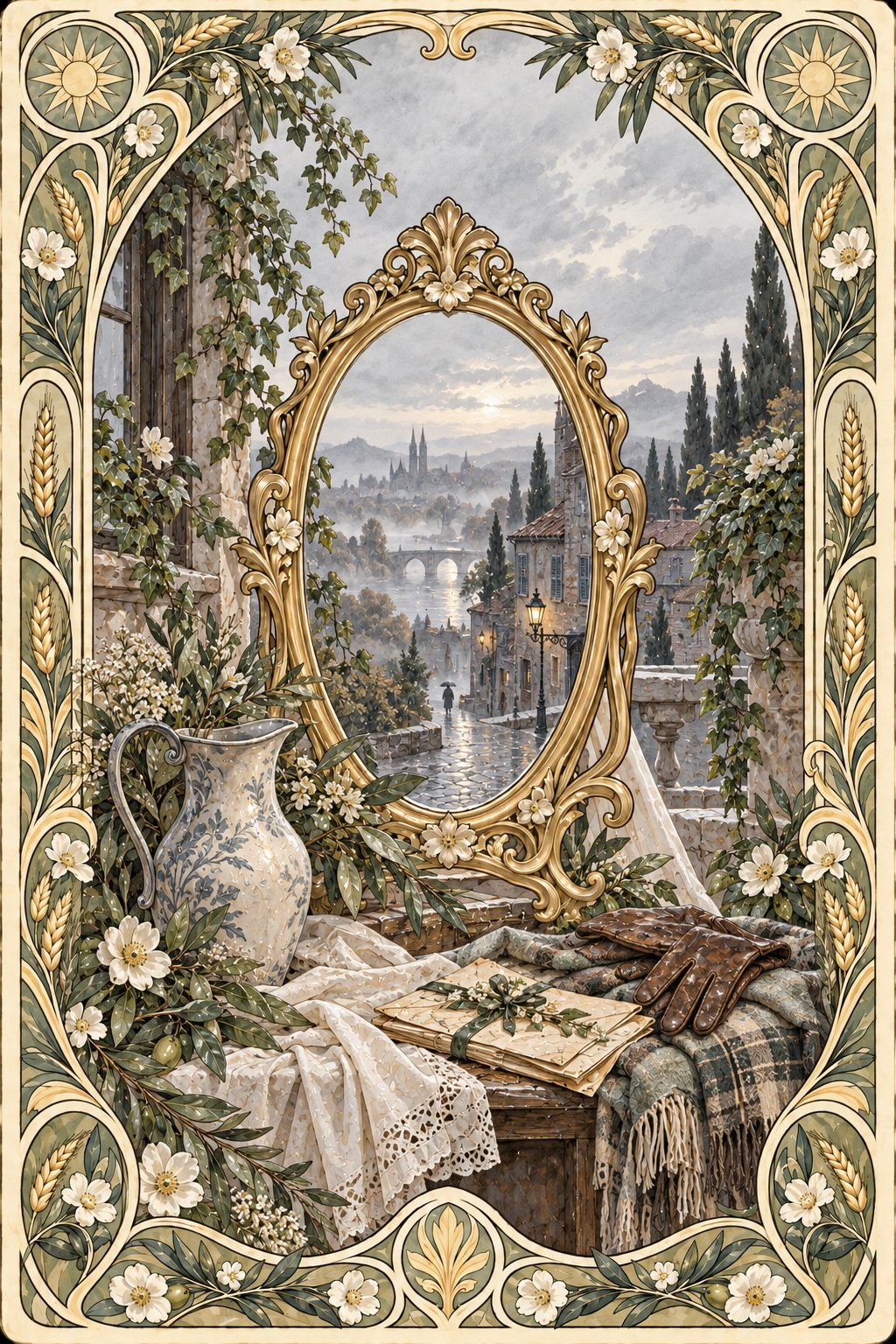
In the card: two figures held by shackles, yet the shackles rest lightly, easy to lift away. The ground is hard, the walls too close for comfort, but the old door stands ajar if anyone cares to see. The air between the figures is silent and stale, carrying the scent of something once fierce, now worn down by time and stillness. Some call this captivity, others call it habit.
There is a street on the edge of a foggy market town, known for its stonework, the pavements and low buildings made from a local rock. The rock is quarried upriver where the current is gentle, and the barges float quietly in the morning. Masons chip away at blocks with their hammers, dust rising, never quite settling, like thoughts that linger but do not bite. In the market square, slabs of this stone form benches and shopfront lintels, all smoothed by the touch of years and the passing of many shoes. Nothing glimmers; nothing pretends.
Long ago, the stone was chosen for the oldest town buildings because it neither shone nor darkened in rain, only softened. Monks carried it into their abbey, using it for the chapel steps and cloister seats. Their robes swept over it, their hands warmed themselves above bread ovens built from it, their nights grew quiet in cells lined with it. The abbey kitchens filled with vessels of pewter and earthenware, simple vessels, bowls and spoons. When the wind howled, the stone absorbed its voice, leaving the corridors calm.
Out on the field boundaries, shepherds built dry walls of the same stone. It shaped the land’s skeleton, marking out what was kept and what was left wild. Sometimes, in early spring, a frost would settle on these walls and across the orchard trees, muting everything. Workers waiting for the thaw would cup their hands around mugs, watching steam rise, the air hushed and weightless. They wore cloth coats stitched from undyed wool, toughened by weather, carrying the memory of sheep and the brushing of brambles. These coats, draped over pegs by the door at night, hung heavy with the scent of air and work, a quiet armor.
The name of the place comes from a borough shaped by quarries: a borough of gains, built on what could be carried away from the hard earth and what was left behind. In the town’s oldest shops, you might still find bundles of fine, pale towelling, woven by hand, stacked for market days. Bakers wrap their loaves in squares cut from discarded cloth, tying them with twine, the bread inside cooling slowly, never burning, never growing cold too fast. When storms gather, the streets and walls take on a hush, as if the town holds its breath, and the roofs shed water with no fuss, everything staying much as it was.
If you wish to unfasten a chain today, you could knead dough on an old stone bench, feeling the warmth rise from beneath your hands. You could wrap yourself in a thick woollen coat and step out before sunrise, listening as silence gathers itself around you. Or you might take a square of plain towelling and wrap it around something precious: a loaf, a letter, a small worry, tucking the corners in as tightly or as loosely as you wish. Set your tea upon a pewter plate, and let the steam drift where it will.
Today's lucky color is Gainsboro.
Lucky Color: Gainsboro — #DCDCDCThe chain is lighter than you think.
You may step out whenever you are ready.