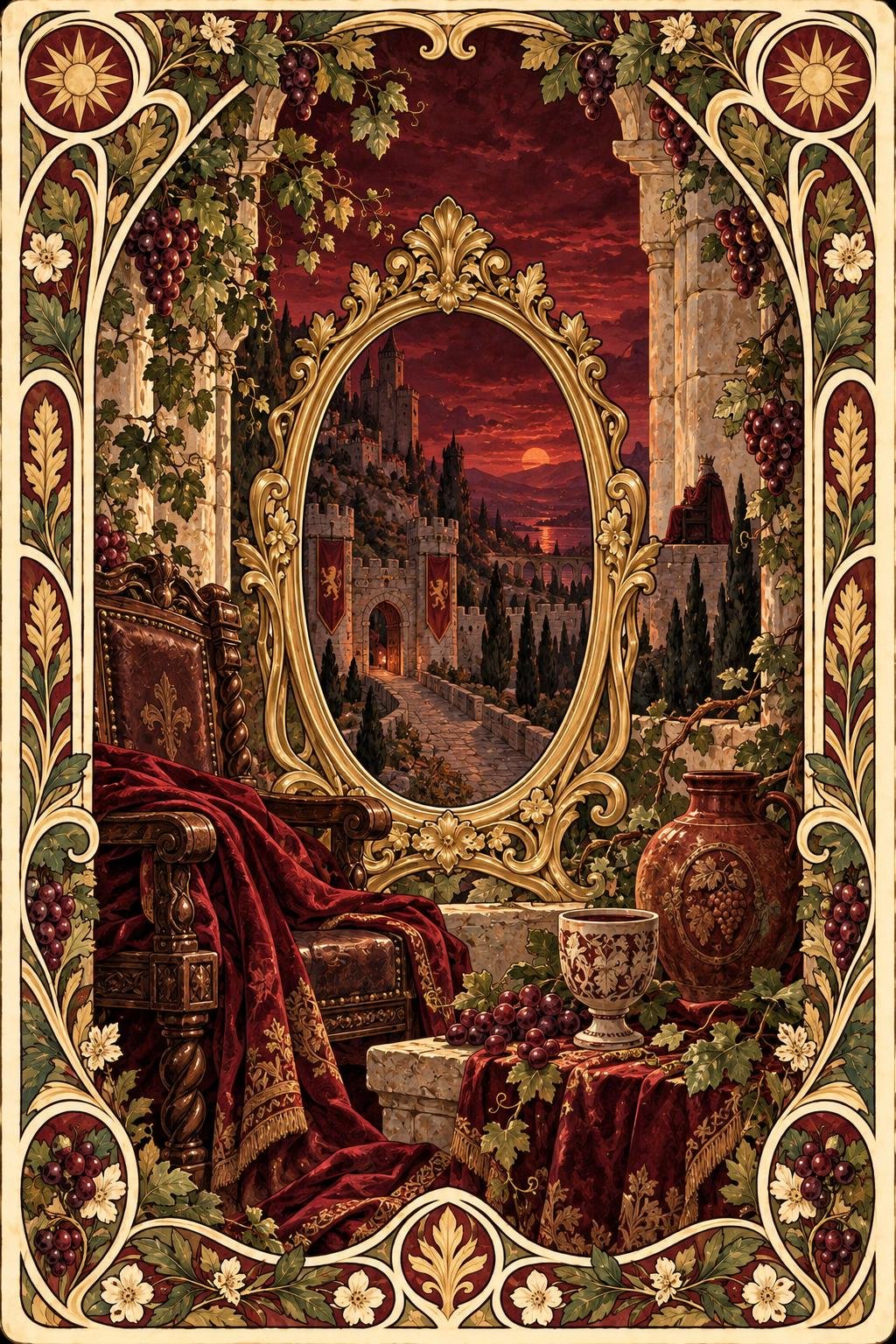
The Emperor sits upon his stone throne, its angular arms worn smooth by years and seasons, casting a distinct shadow over the dry, tough grass at the edge of a mountain pass. Behind him, peaks rise like guardians, their ancient strength holding the world in place. In front of him, the road is marked with stones, laid in careful lines, a visible record of boundaries kept. Order is not an accident—it is built, one foundation at a time, and then watched over as the wind and weather try to reclaim it.
In the stories of the world, a certain thread marks the Emperor’s path: the lacquered surface of an old writing desk, a family heirloom, its polished finish bearing the marks of generations. Here, land deeds and appointments are signed, the clatter of a seal opening the business of the day. Along the shelves, clusters of chestnuts, gathered and roasted in autumn, wait in a ceramic bowl, lending the air a savory, earthy scent. Chestnuts, like rules, are gathered only with patience and the knowledge of when the shell will yield. Nearby, an old woolen cloak, kept for winter, is folded with corners aligned, its weave tight from long use, the scent of cedar clinging to its threads. These objects are not simply possessions—they are tools of continuity, each a boundary that defines a home.
Beyond the walls, the Emperor’s legacy is echoed in the landscape. Bands of iron-rich earth stretch across distant hills, veins exposed where the digging has laid bare the world’s structure. In certain lands, the bark of the mahogany tree is harvested with precise cuts, the lines straight and measured, never wasting what is given. The trunk’s fibers, when shaped into furniture or carved into a ceremonial staff, speak of order and endurance. In the far east, there is a tradition of drying fruit from the persimmon tree, sliced and arranged on trays, the slices becoming leathery and sweet in the dry, cold air. These fruits, preserved for the season when the snow closes the passes, are a sign that someone has made ready, that the world within these boundaries will last.
The weather, too, has its own order. On certain afternoons, when the equinox nears, wind sweeps down from the mountains, carrying the scent of wet clay and fallen leaves, swirling dust that settles quickly once the gust has passed. This is not the wild, ungoverned storm, but the measured breathing of the land, a rhythm that matches the Emperor’s own: inhale, exhale, return. After the wind, the air feels steadier, as if the invisible boundaries have been drawn again, and all is in its place.
A person today might honor these boundaries by arranging their workspace so that each tool has its proper place, and the desk is left ready for the next task. They could prepare chestnuts or another harvest, roasting them and sharing with someone dear, as an act of gathered patience. On a cold evening, unfolding and folding a heavy cloak with care, or repairing a seam, might be a small act of order restored. Finally, writing a letter and sealing it, placing it where it will be found, can serve as a reminder that order and continuity walk hand in hand.
Today's lucky color is Maroon.
Lucky Color: Maroon — #800000The boundaries you tend today will shape the roads you walk tomorrow.
Endure, and build.