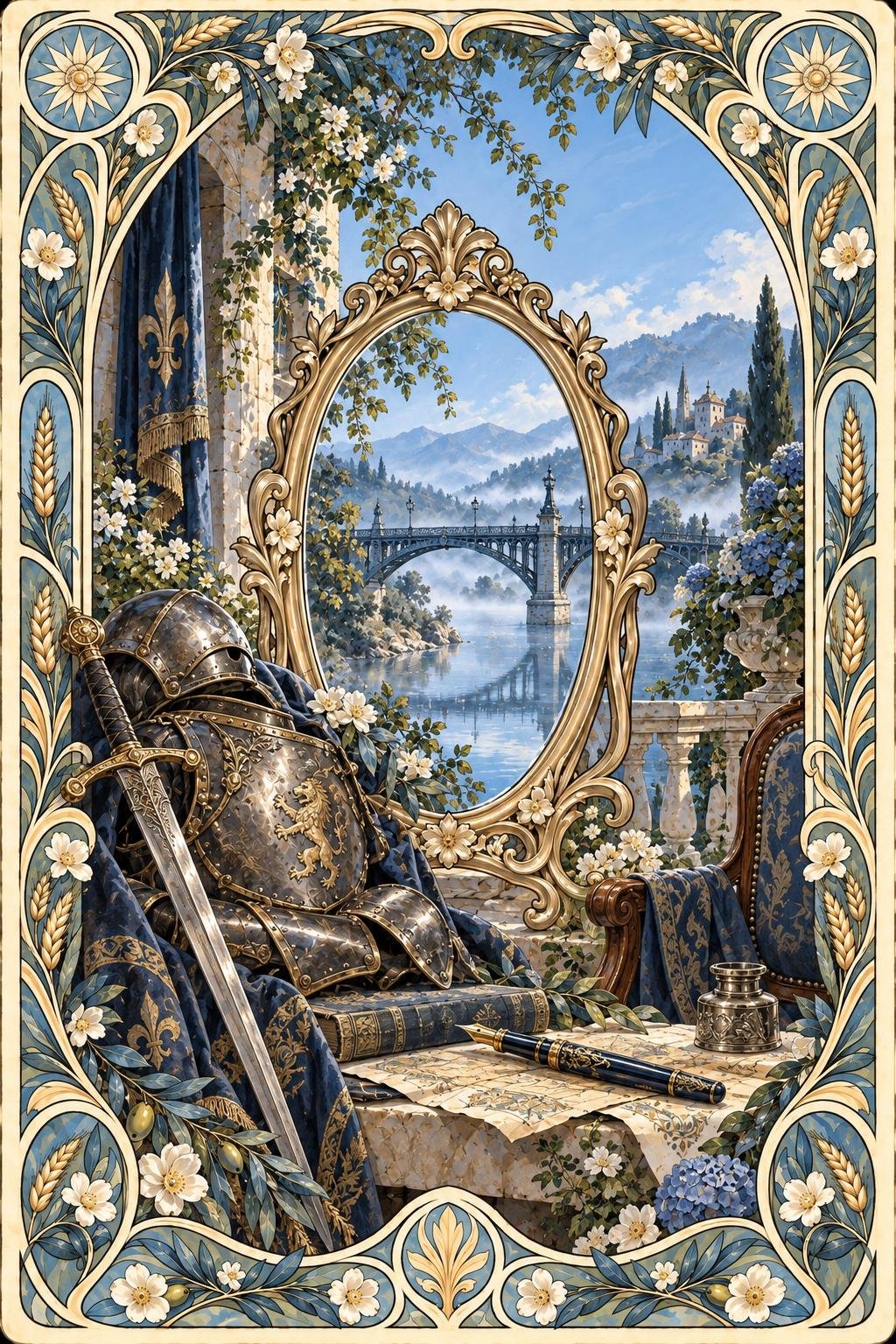
The Emperor sits on a stone seat, unmoved by storms or shifting seasons, his outline as definite as the sharp edge between valley and peak. Behind him rise the mountains, cold and ancient, their ridgelines cutting the horizon with the certainty of law. In the mountain air, every sound carries farther—goat bells, the clink of a smith’s hammer from a distant village, the steady order of things maintained by habit and by rule. Here, in this landscape, the Emperor does not rule by whim. He waits, watching the way wind shapes the snow, the way the path stays clear because someone—always someone—shovels, sweeps, and repairs the stones.
In the valleys below, fences mark out fields and pastures. There is a boundary between wheat and scrub, between meadow and the wilds beyond. Villagers build with iron and stone, tools forged in the mountain forges: the head of a hammer, the shank of a spade, the frame of a gate, all cold to the touch in morning air. At daybreak, the sky above the forge carries a metallic sheen, caught between day and night, never quite surrendering to either. The smith lifts a length of iron from the coals, letting it cool to a dull luster before shaping it into something useful: a blade, a horseshoe, a hinge that will creak through generations of doors.
Order is not only in the tool but in the way the tool is used. The shepherd rises to count the flock by the same method each dawn. The baker weighs out flour, kneading dough atop a worktable that belonged to her grandmother, the grain of the wood polished by decades of hands. The merchant opens his ledger, drawing lines and numbers with a ruler’s sure guidance. Each act is a boundary, a promise that today will proceed much like yesterday, not out of staleness but out of trust in what endures. Even the weather respects such routines: when the wind sweeps down from the mountains, it brings a chill that signals the hour for shutters to close, fires to be lit, and neighbors to exchange news at the threshold.
Steel and stone are not just the Emperor’s seat, but the pattern of daily life. In ancient cities, the clang of armor on the city gates marked the beginning and end of the watch. Along the riverbanks, bridges built of iron lattice hold steady against spring’s floodwaters, allowing travel and trade to continue uninterrupted. In the harbor, the hulls of ships—plate and rivet—wait for tides and orders, their surfaces misted with salt every morning. Far inland, the rails of a train line bind distant towns, each length of metal laid down by careful hands. What is made to last, lasts not only by strength, but by the discipline and rituals that maintain it.
Today, order may begin with a small act: sorting tools after use, tightening the hinge on a gate, or drafting a schedule to frame the unpredictable hours. You might write your plans in a notebook with ruled lines, or walk a familiar boundary—your garden wall, a fence, the edge of a field—marking what is yours to care for. Let the settled procedures, the traditions of your place, give you steadiness. The Emperor teaches that a road is kept not by chance, but by the hands and habits that tend it every day.
Today's lucky color is SteelBlue.
Lucky Color: SteelBlue — #4682B4Let your structure serve as comfort, and your routine as strength.