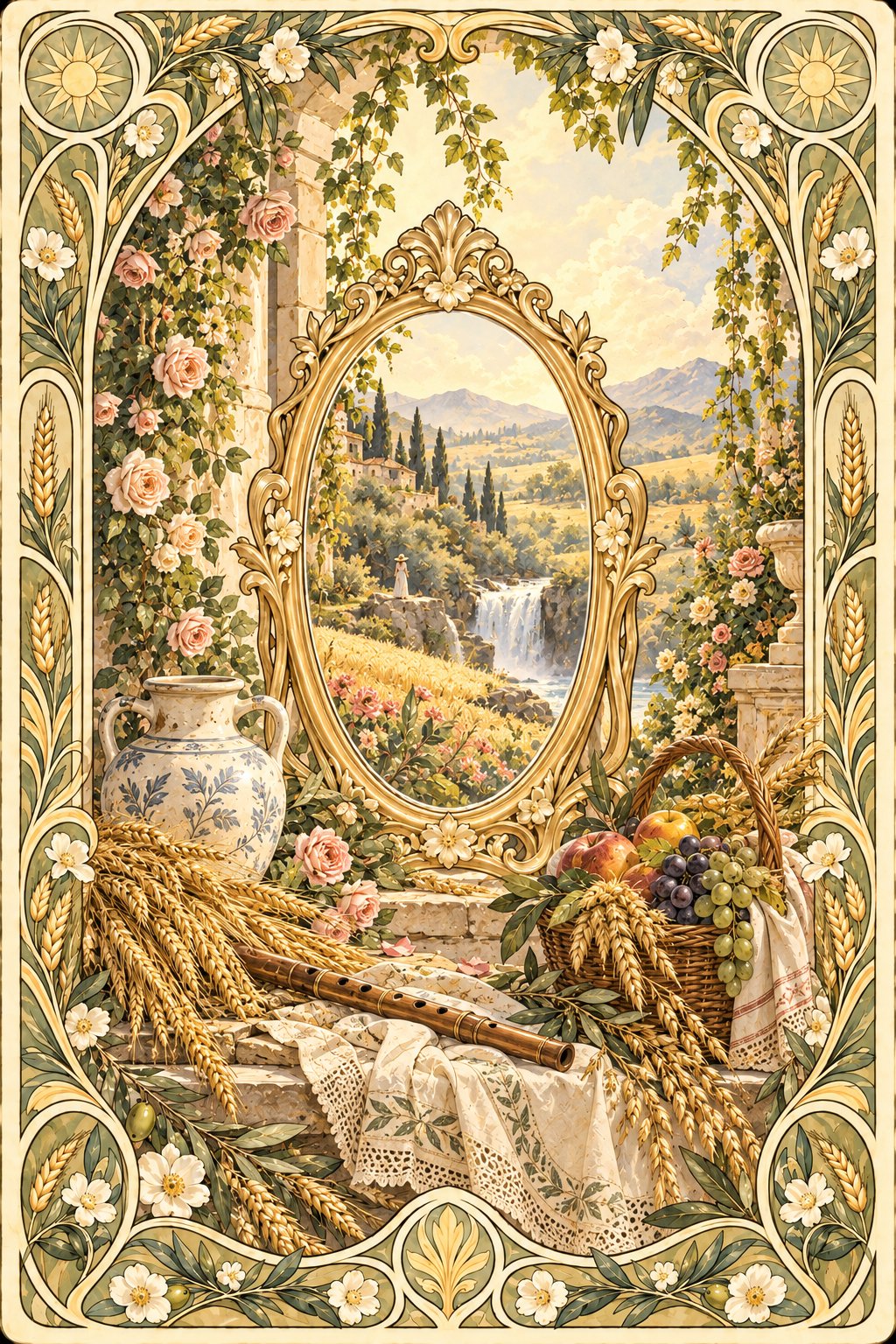
Wheat nods in the sun, heavy-headed and ready for the sickle. The garden stretches out under a sky that promises both warmth and rain, and the Empress sits among her roses, her seat carved from wood and softened with a plaited mat. Around her, the fruit trees bend with pears and plums, and just beyond the low stone wall, a waterfall slides over mossy rocks, tumbling into a pool where dragonflies hover. The earth is full, offering up what it has made. The signs are not subtle: abundance is everywhere, woven into the stalks and thorns and the pulse of water on stone.
In the fields, the outer sheaths of maize whisper in the wind, the soft threads that gather at the tip of each ear shimmering in the afternoon. These threads, delicate but strong, slip through fingers at harvest, tangling in long baskets and catching the memory of sunlight. There is an old belief, carried on from river valley to prairie, that these threads can be twined into dolls to watch over the granary, protecting stored grain through the winter. In some villages, these threads were once left in small bundles at doorways after the harvest moon, a wish for security and a year of full cupboards.
The Empress knows these rituals, their quiet repetition echoing the turning of the seasons. Women in kitchens run their hands over woven mats made from fibers gathered during the harvest. They place heaps of bread, still fragrant from the oven, onto these mats—the bread itself flecked with the tiny filaments that recall the field. On feast days, children are sent to gather the silk from the garden’s borders, to be tied into bows for festival hats, or braided near the base of candles lit for ancestors. Elsewhere, traveling merchants carry bags lined with this soft stuff, believing it cushions the precious jars and preserves within from the jostle of the road.
Near rivers, in places where the air grows thick with midsummer heat, whole stands of maize stand as high as a man, their ears wrapped up in layers of husk and crowned with this gentle fringe. In folklore, people would say that the weather carried the scent of the fields into the home, especially after a morning rain when the air was fresh and the light caught on every thread. A grandmother might set a basket of these threads beside the kettle, using them to tie bundles of herbs, or to line the bottom of a pie tin so the crust would not stick. The memory of plenty is stored in these small acts, as much as in the loaves and the jars put up for winter.
For someone who sits with the Empress today, a small thing could be to visit a garden or market and look for the threads at the tops of corn, handling them as one would handle something precious and alive. It might be as simple as setting a woven mat on a table before a meal, or saving a few strands to tie around a jar of preserves as a reminder of the fullness of the season. You could try weaving a small doll or ornament from these threads, offering it to a friend or placing it on a windowsill where the morning sun finds it. Each of these gestures gathers a bit of the world’s abundance, making it tangible for the day ahead.
Today's lucky color is Cornsilk.
Lucky Color: Cornsilk — #FFF8DCAbundance lives in the small, tangible threads. What you gather today, you keep.