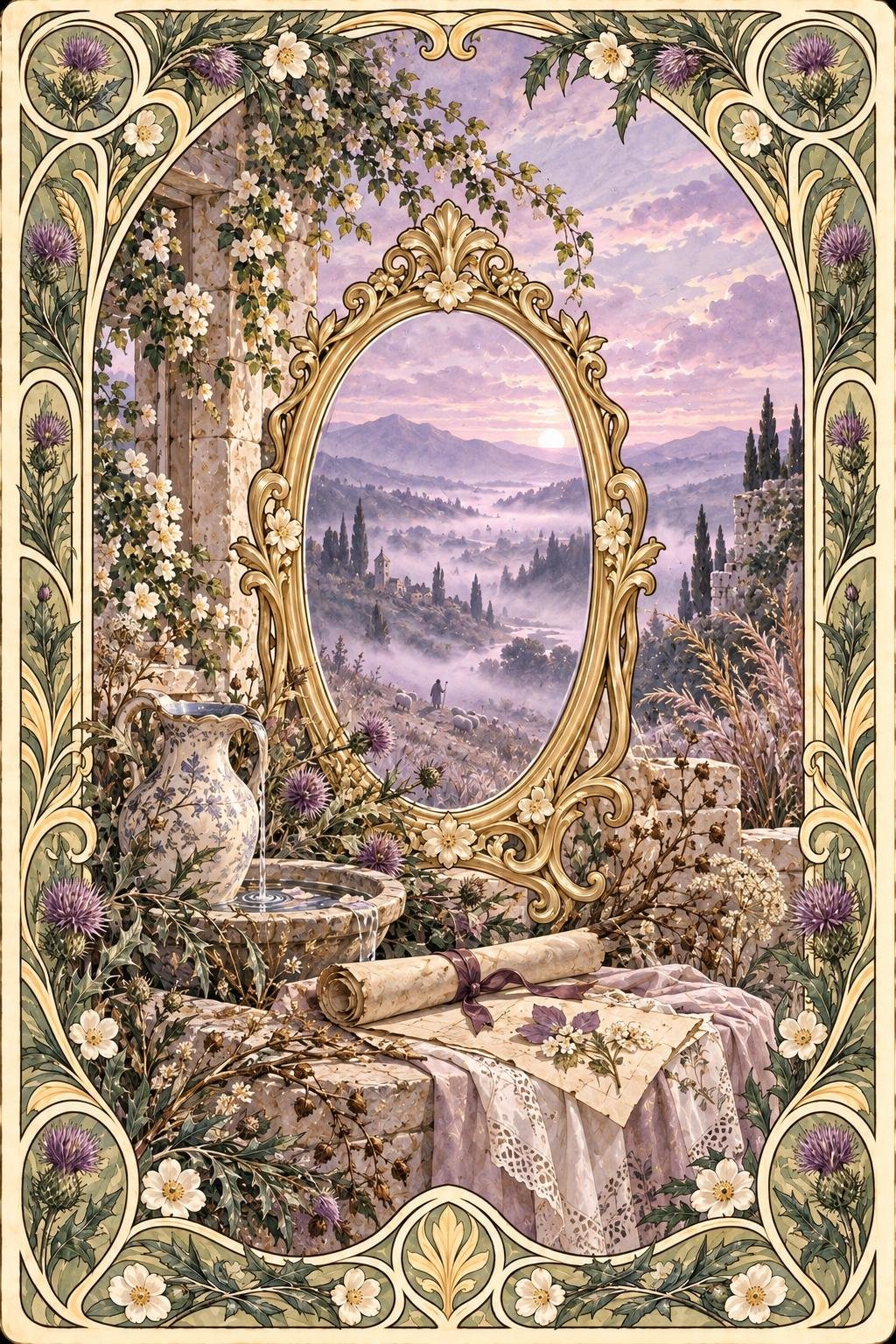
The presence of the High Priestess reversed is like a sealed door in an empty corridor, the curtain pulled tight across her sanctuary. The scroll she holds never opens; its letters are closed lips, promising nothing to the seeker. Water pools at her feet but keeps its reflections to itself—there are no ripples, no revelations, only a silent surface. In this place, what might have been a path to inner truth has transformed into a barricade. The secrets are not waiting for you; they are pressed downward, like roots that wind beneath hard soil, unreachable, yet alive.
Across windswept moor and rocky pasture, a plant grows that knows this language of guardedness. Its stalks are armed with defiant spines, protecting tufts that bloom against the chill. Centuries ago, shepherds and travelers brushed sleeves against these plants, sometimes snagging wool or cloth on the sharp leaves. In Scotland, the plant became an emblem—its bloom a sign of silent endurance, a resistance to being claimed or understood too easily. Its heads bob in the cold north wind, clustered tight along forgotten footpaths, holding the hillsides in a stubborn embrace. Here, the plant thrived where others would not, drawing its own boundaries on the land.
Folk tales grew up around its unyielding nature. Children were warned to watch where they sat, lest they press their hands or knees into the spines. Yet in kitchens and crofts, the same plant was carefully harvested. Its seeds, picked free from the tangled heads, were ground to mix with barley flour for bread that fed families through lean months. Some would roast the seeds, coaxing out a faintly nutty flavor for teas believed to soothe or strengthen, the bitterness a reminder of hard places and hidden gifts. The tough stems, once dried, became household brooms—sweeping floors clean with the same stubbornness with which the plant clung to the earth. In this way, what seemed untouchable became woven into daily life, a secret made useful.
Along old roads, travelers would knot bits of linen or wool to the prickly stalks, trusting some silent wish might be carried by the wind or guarded by the plant’s bristling form. In some villages, roots were boiled for a medicinal tonic; the scent rising from the pot spoke of rain-soaked fields and the memory of hands digging through stony dirt. The plant’s presence in the world was a quiet defiance, an answer given only to those willing to reach in past the thorns.
Today, a person could wander the edge of a vacant field, seeking out the defiant stalks for a small spray to place on a windowsill, a shield of sorts. Seeds could be gathered and ground into flour for rustic baking, or steeped as an infusion that carries the taste of open hills. You might use a broom made from its sturdy stalks to sweep the threshold clean, or tie a thread of old fabric to a plant where two paths cross, letting your secret ride with the wind and the rain.
Today's lucky color is Thistle.
Lucky Color: Thistle — #D8BFD8Even what is most guarded can quietly transform the day.