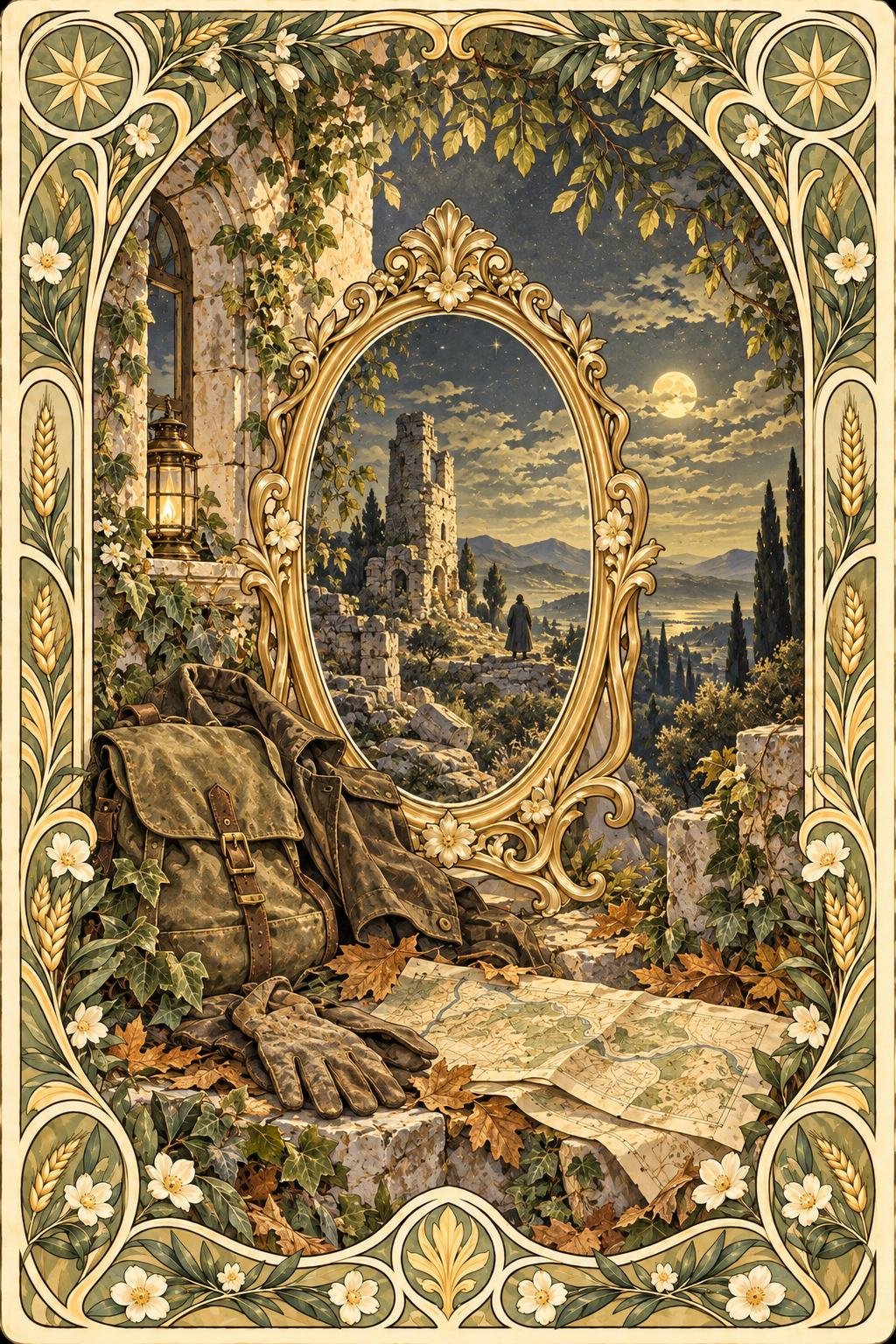
A high structure shakes in the wind, stones loosened but still clinging, the shape of order held by sheer memory. The jagged break in the masonry gapes like a wound not yet permitted to bleed. Lightning stains the far horizon, threatening, stalling. Inside, the air is thick with dust and suspense. In the world of the reversed Tower, the disaster holds its breath; the shattering is delayed, the form remains stubbornly upright. It is the story of the fortification that should have fallen, but whose walls pretend at wholeness, even as the mortar crumbles within.
Along the base of the tower, beaten paths made by soldiers’ boots tell of centuries of vigilance. The earth is pressed flat, pressed dull, a stubborn record of men who were told to stand their ground. That same earth, decades ago, was dug up and filled into canvas sacks for the trenchlines, pressed into rough cloth, shaped into uniforms designed to blend in with the very dirt. In the high heat of far-off plains, an army once stood at the edge of collapse, sweat trickling down their bodies beneath sturdy jackets whose fibers bore the memory of dust storms and the work of the dyer’s hand. The cloth was functional, practical, a second skin built for endurance, colored to vanish into withered grass or a cloudless haze.
Elsewhere, the story runs backward to the old markets, where traders weighed bolts of tightly-woven fabric on bronze scales. The cloth was sought after by merchants traveling along riverbanks and camel paths, crossing from Punjab to Cairo and beyond. When the monsoon failed and the roads turned to powder, the traders continued, their wares protected from the sun and the wind by the same weave that kept soldiers safe. At home, women embroidered those sturdy tunics for sons and husbands, fingers pricked by the sharp little needles, the scent of dry straw rising from the working floor.
Plant the same grass along the edge of a crumbling wall, or kneel to weed it. Taste flatbread made from wheat ground in the stone mills that turn at the edge of the desert, where the wind carries dust from ancient fields. In the kitchen, take up a worn muslin towel, wrap it around warm bread, and remember the smoothness of sun-dried stalks bundled for market. In the quiet afternoon, pick up a battered canvas satchel, run your hand along its surface, and recall its journey through customs and checkpoints, a vessel for the ordinary miracles of survival.
A sandstorm rolls in, its breath hot, its edge blunted by rows of bundled reeds and tarpaulin stretched between tent poles. The sky is weighted with suspense. The great collapse has not yet arrived, but every tool, every piece of cloth, every handful of grain keeps the old form standing a while longer. A settlement endures because it learns to wear the color of endurance, to disappear in plain sight, to claim the name of the thing it most needs to survive.
Today's lucky color is Khaki.
Lucky Color: Khaki — #F0E68CThe walls still stand, even as the air whispers collapse.
Hold fast and vanish into what endures.