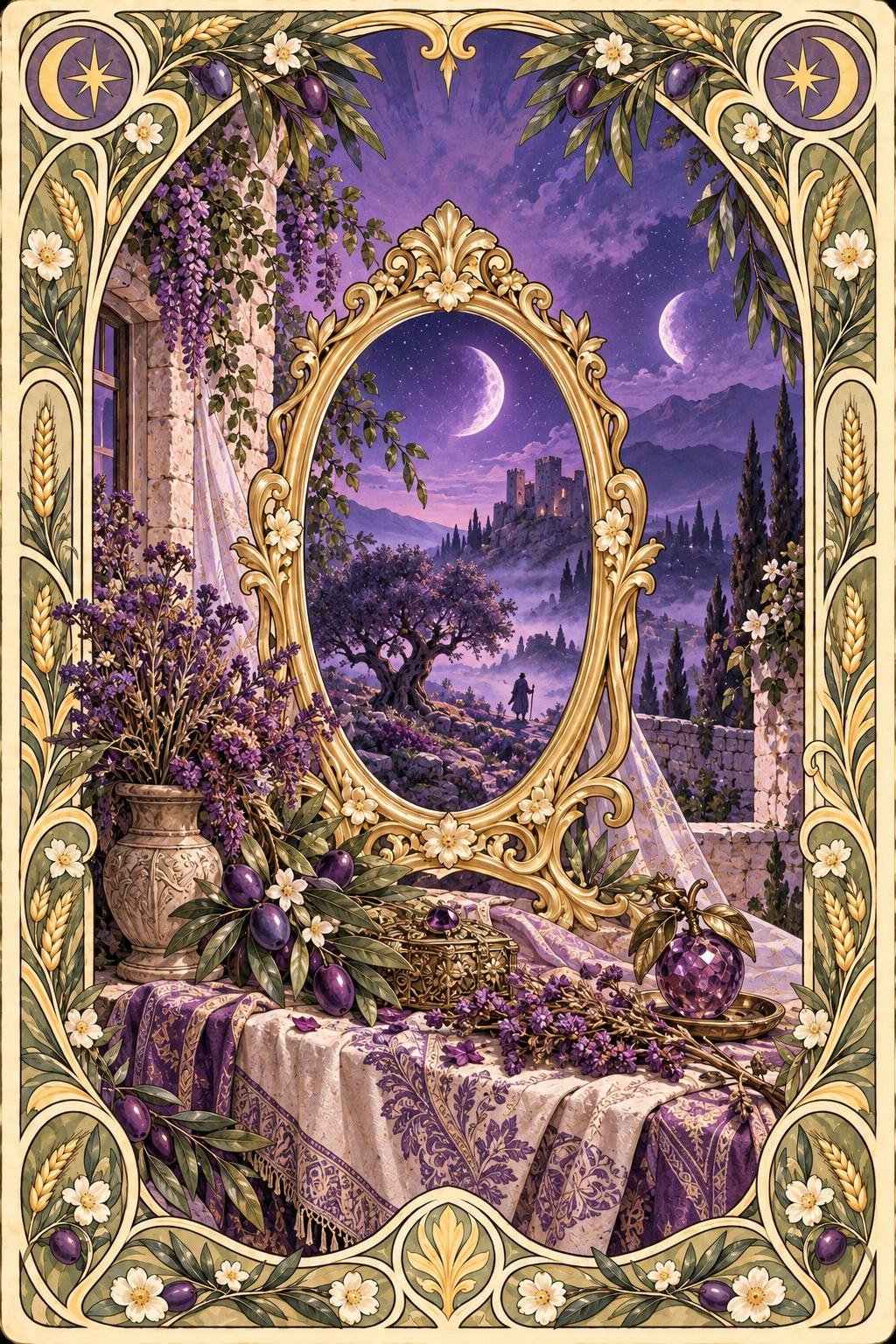
At the heart of the World card, a dancer steps lightly within a circle of laurel leaves, arms raised and eyes cast serenely outward. The four living creatures—lion, bull, eagle, and angel—hold the corners of the scene, watching as the sequence of events reaches its final cadence. The dancer’s ribbons arc in the air, tying up the circuit, sealing the enclosure. It is a moment not just of celebration but of completion: the journey around the wreath is done, the story has reached its resting place. This is the harvest that follows long work, the feast that comes after months of planting, tending, and waiting.
Once, in ancient Tyre and Sidon, the conqueror’s cloak and the merchant’s veil alike bore the mark of a rare shellfish. Fishermen would wade into the Mediterranean’s shallow waters to collect the slender mollusks, breaking open the shells with stones on the shore. They would set the flesh to steep and watch as the brine darkened, slowly infusing yards of linen that only the privileged could afford. The Romans called this dye “imperial,” and with it they edged togas, stitched banners, and conferred the right to rule. The color marked a threshold—who could approach power, who stood at the gates, who had circled the city and entered its heart. To wear a thread of it was to be known, to be completed in the eyes of the world.
In autumn, on the high fields of Thessaly and Kashmir, crocus flowers bloom through the stubble of harvested grain. Each blossom, fragile and rare, cradles three filaments deep inside. At daybreak, workers pluck them by hand, little baskets filling slowly as fingers grow numb from the cold. When the day is done, the strands are dried over embers—a process as delicate as the blooms themselves—and then tucked away to flavor and color food for winter feasts. On festival nights, families gather to stir rice and milk, breaking the long fast with a spoonful of the world’s costliest spice. It is a taste reserved for endings and beginnings, for tying together the circle of a long year.
There are places where this tone appears not only in fabrics and food, but in the air itself. After a summer storm, when the sun dips low and the distant ridges catch the last light, the hills of Provence and the Scottish heather moors gleam with a subtle haze. The air is filled with the scent of earth and the promise of rest. Shepherds move their flocks home, lamps are lit in doorways, and the day’s labors are set aside. Such evenings feel complete—everything gathered in, nothing unfinished—and the world seems gently enclosed by a ribbon of dusk.
In the household, echoes of this completeness appear in the silk lining of a winter coat, the crest embroidered on a scholar’s hood, or the wax seal pressed firmly onto a letter before it is sent across the sea. There is a certain candle that, when lit, marks the closing of a season or the beginning of a new chapter; its fragrance lingers, reminding all present that something important has come full circle. In kitchens, a handful of tiny petals steep in cream or water, giving a simple dessert the taste of patience and culmination.
Today, a person might tie a ribbon to their wrist, walk the edge of a field at dusk, or set a tiny bowl of saffron threads beside their window. They could send a letter sealed with wax, or end the day by lighting a candle whose scent marks both arrival and return.
Today's lucky color is Purple.
Lucky Color: Purple — #800080The World completes the dance with grace. A ribbon ties the circuit closed.