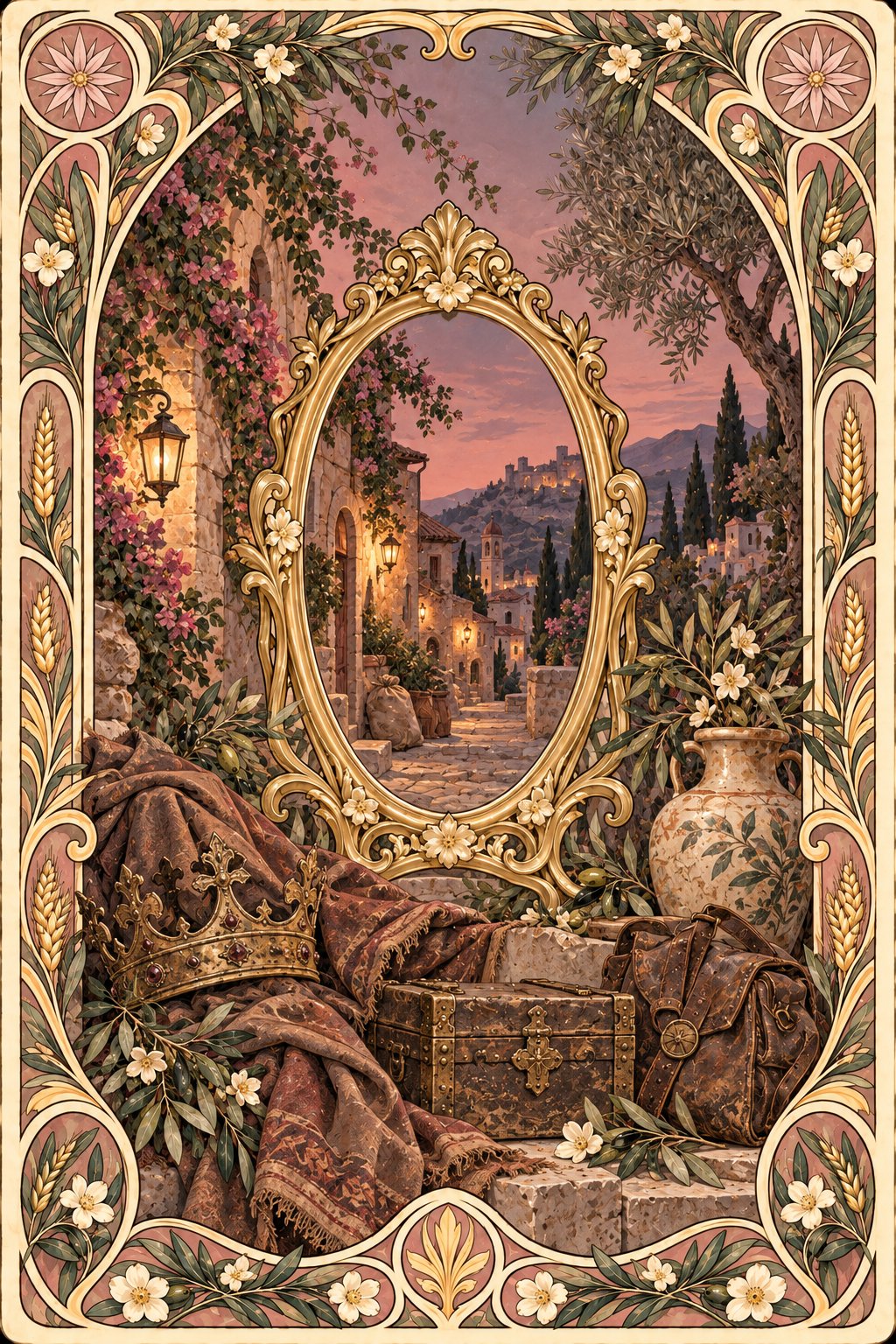
On the old card, the armored figure pauses, the horse’s hooves still. The banner remains unfurled, but here, in this reversed turn, nothing moves forward. The crown fallen at the figure’s feet is picked up and held, not with hope, but with a hand that cannot release. What should slip away instead lingers, as though history can be cradled and the first pale light behind the hills can be ignored.
In the dim rooms of forgotten palaces, there are relics in glass cases: gloves stiffened from disuse, tarnished brooches, and faded letters sealed with wax. If you look close, you’ll see the faint powder that falls from withered rose petals, pressed between the pages of old books. These are the collections of those who cannot let endings happen—their memories held in the scent of dried flowers, the grain of long-worn leather, the blush of an apple left too long on the branch. The air in these spaces is tinged with a memory of cinnamon bark, warming the hearth though no fire burns.
Traveling across the ancient steppe, one finds the weathered hide tents of those who carry their past with them. Rugs woven on grandmother’s looms are spread on the earth, their patterns softened by countless feet. The dusk wind brings a haze, not of storm but of dust rising from the trail where herds have passed for generations. Under the stretched canvas, tea steeps in cracked clay cups, its fragrance a quiet reminder of the hands that shaped both vessel and leaf. Here, the past is worn as a cloak against the chill, stitched into the seams of daily life.
In the corners of kitchens, mortars carved from orchard wood sit heavy on the shelves. They have ground spices for the same soup, prepared for the same table, for years beyond memory. The handles of wooden spoons are smoothed by use, and even as recipes change, a mother’s careful stirring is repeated without thought. Some evenings, the last root vegetables are brought from the cellar, their skins showing the mottled softness that comes with time. They are peeled and diced, simmered into thick broth, and served in bowls that have seen both celebration and mourning.
From the high hills of Anatolia, shepherds still shape felt from lamb’s wool to make their hats, the same way their great-grandparents did, beating the fleece against stone and molding it with their hands. In the spring, the wild roses blossom along the hedgerows; they are gathered and pressed into sweet preserves, spooned onto the morning flatbread. The petals, once vivid, become translucent in sugar, a memory of fragrance clinging to the tongue.
When the old crown is kept in the hand, endings become museums, not meadows. The first rays of dawn slip by while the keeper turns the artifact over, again and again, unwilling to let it rest. Yet, gentle acts may help: press a rose between pages of a book, save the last slice of warm bread for a friend, polish an old spoon and stir your morning tea with it, or write a letter and seal it in wax, even if you do not send it. These are gestures to honor what remains while letting the morning come in.
Today's lucky color is RosyBrown.
Lucky Color: RosyBrown — #BC8F8FLet go gently, so new light may enter.
The dawn always waits beyond closed doors.