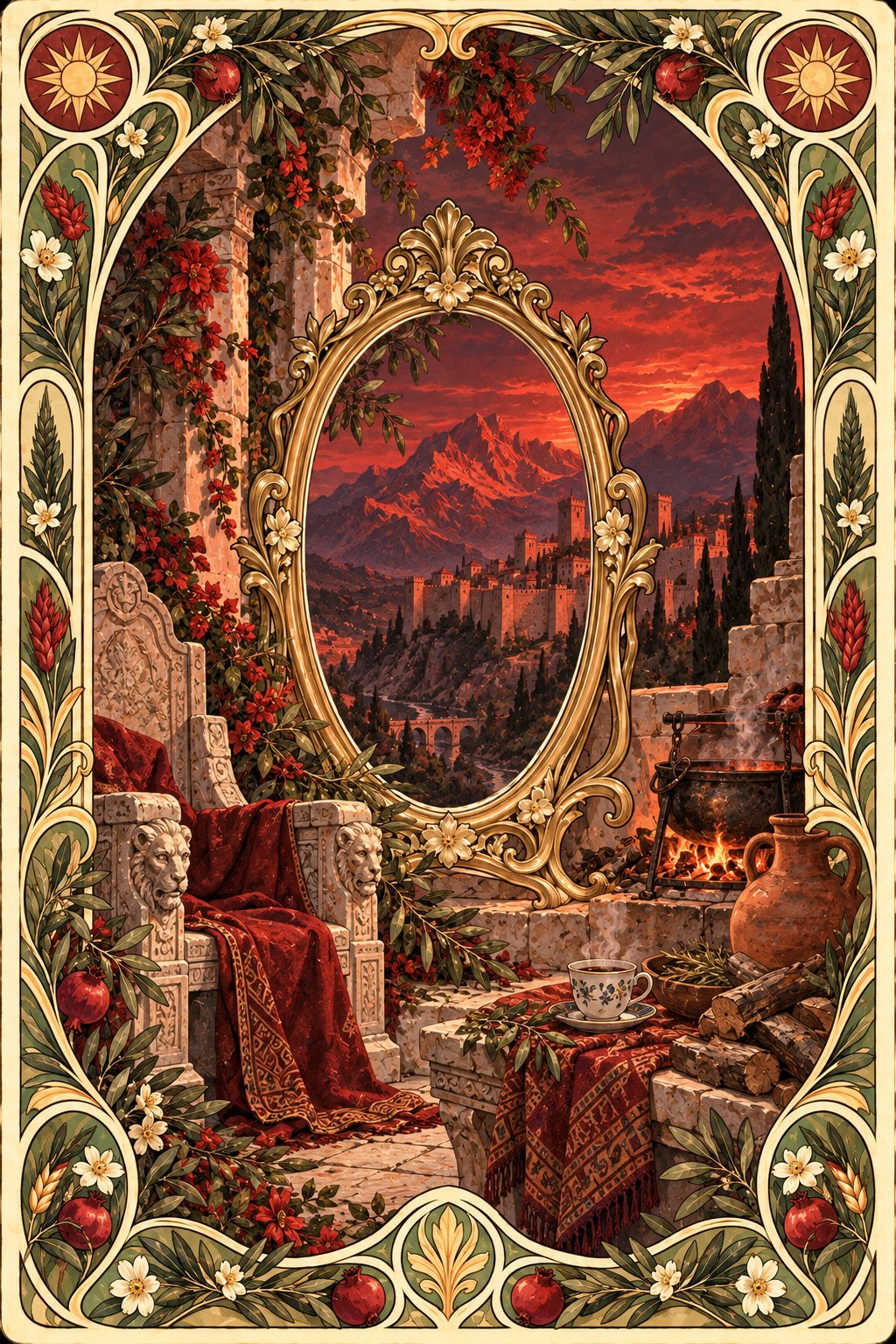
The Emperor sits on his stone seat, a place shaped by hands that knew the weight of authority. The back is straight, the arms broad, and each line marks the memory of a quarry, the discipline of the mason’s mallet, and the patience of lime and sand pressed into form. Where he sits, the mountain’s vein still runs beneath, and the seat draws its strength from centuries of settled earth. All order finds its beginning in boundaries, and all boundaries are traced on ground that will not yield to wandering.
Below, in the city at his feet, the order imposed by walls and gates echoes in the heart of the hearth. Each house holds a kiln, tended daily, where clay is shaped into brick, then fired in rows until they harden. These bricks build the arches over alleys, the steps up to the council hall, the oven where bread bakes at dawn. Their mass is a comfort, their pattern a promise that nothing will falter so long as every piece is set and watched. Over the years, the city has grown outward, each new district marked by the laying of these bricks, their presence a signal that new order has arrived and the wildness is held back for another season.
In the midday heat, the walls of these buildings absorb the sun, holding it in until dusk. The square in front of the Emperor’s seat is paved with the same substance, the stones smooth from generations of feet. At the corners, street vendors nestle iron stoves into old brickwork, building makeshift forges where metal is shaped for plows and hinges, and the scent of roasting food mingles with the sharp tang of iron and ash. Sometimes, after rain, the bricks steam in the afternoon, radiating the storm’s memory back into the air, their surfaces slick but steady beneath any who walk there.
Beyond the city, the mountains stand in parallel, a weathered wall themselves. Shepherds guide their flocks through narrow passes, marking the territory where fields end and the wild begins. In these high places, boundary stones, set in the same manner as the city’s bricks, show that someone has claimed this land, that even in the thinnest air a line can be drawn and kept. Stories are told around mountain fires, of kings who once built mighty fortresses with these same bricks, their glory and their downfall set by how well they maintained the procedure of order.
Inside, in the palace kitchens, loaves rise within domed ovens lined with familiar bricks, and pots simmer on stoves that breathe with steady warmth. The Emperor’s robe is trimmed with thread like the bricks, the pattern a signal of rank, the texture a memory of the patience and control required to weave good governance from daily habit. In the evening, as the sun sets behind the mountains, the last light catches the outlines of the city’s tiled roofs, each one laid by hand, each one evidence that order can shelter a thousand lives.
Today, a person can place a small brick on their desk as a reminder to finish what they begin. They can follow a settled routine in the making of bread, kneading and shaping before setting dough into the oven. Lighting a fire in a well-built hearth or arranging books along a shelf in neat rows will invite a sense of solid, sustaining order. In all these things, the procedure—steady, practical, and bounded—protects the road ahead.
Today's lucky color is FireBrick.
Lucky Color: FireBrick — #B22222Order endures through what the hands build.
Stone and kiln make the way strong.