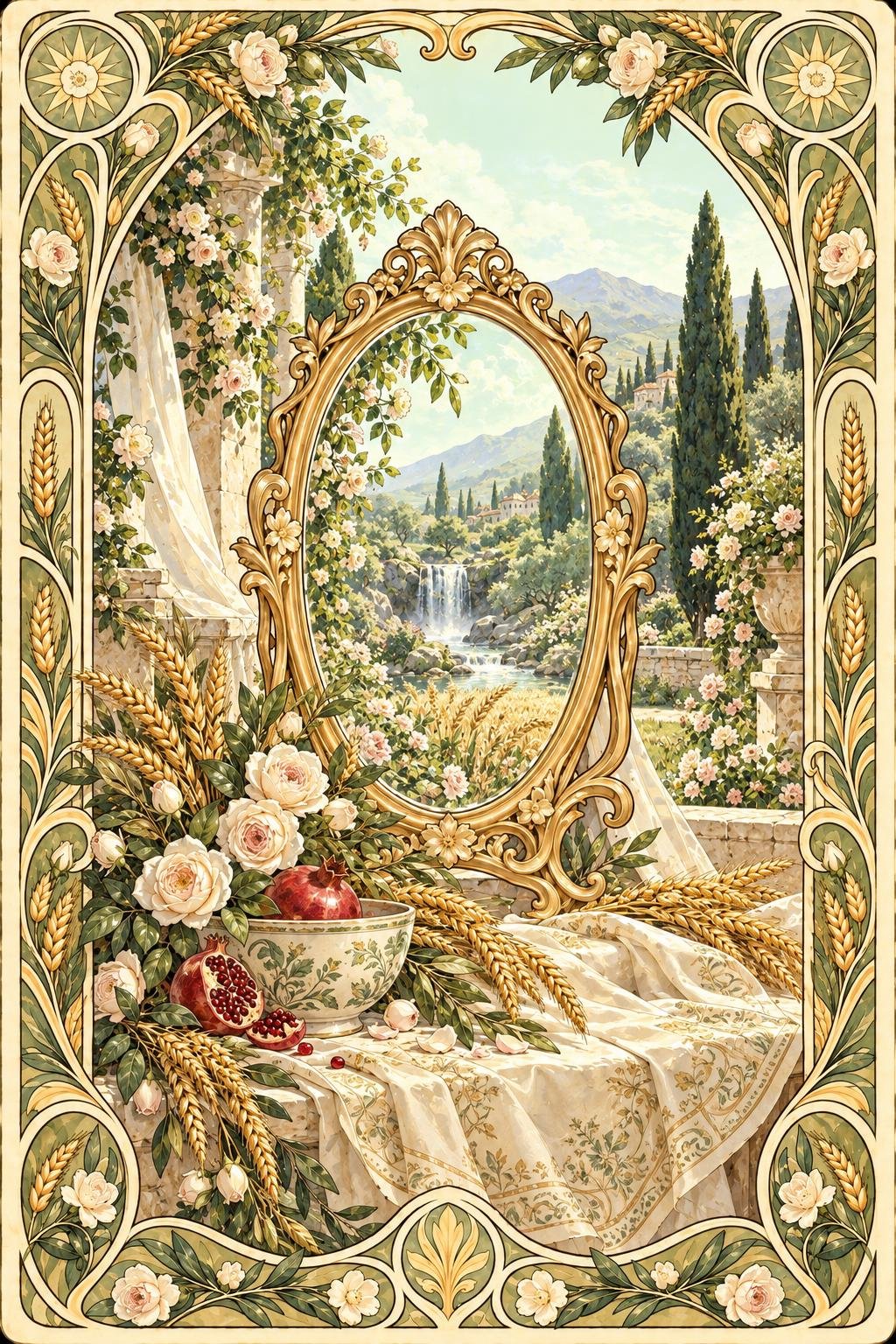
The Empress sits in a garden bordered by wheat and roses. Beyond her woven seat, a waterfall moves along a quiet bank, feeding the roots of fruit trees. The garden hums with abundance, not in riot, but in gentle, even tones. Under her hand, a basket rests, holding the day’s first harvest: apples, pears, heavy and ready to split, and a melon, just cut open. Its rind is smooth and cool, the flesh inside almost clear and softly sweet, a reminder that abundance can be pale and quiet, never shouting for attention.
In the ancient markets of Anatolia, melon sellers would arrive at dawn. The fruit was prized not for a show of color, but for its subtle, cooling quality in the heat. Nomads crossing the dry hills wrapped slices in linen and carried them at their waists, their fingers sticky with juice by midday. The patience of waiting for the right morning, the right firmness beneath the thumb, was handed down through generations. Later, in monastic gardens across Europe, melons were cultivated in quiet corners, alongside medicinal herbs and soft-leaved lettuces. Nuns would cut them into fine crescents, arranging them beside bowls of goat’s cheese for cooling midday meals in the cloisters.
Water, too, follows the Empress. In the old stories, morning mist on the grass was called “the sky’s offering,” and villagers would rise early to collect it from cabbage leaves and garden nets. This dew, gentle and easily lost, was thought to feed the first shoots of the season, promising fruit later. In the household, a jug left by the open window would fill with this faint wetness through the night, ready to be poured into the roots of climbing beans or mixed into bread by dawn.
Among the Empress’s gifts is the honeycomb, pressed and veined, a trophy brought in by the beekeeper’s careful hand. When bees rise after a cool night, their wings dusted with the garden’s gift, they slip into squashes and cucumbers, making the air quiver softly. The honey gathered in early summer is mild, almost translucent, and tastes of new grass and the small flowers that hide under hedges. In the kitchen, a spoonful is stirred into morning tea, or smeared on oatcakes, keeping the body steady and calm.
Weather here is gentle, neither hot nor cold, a soft light in the morning that encourages slow work. In old English walled gardens, caretakers would check the melon cloches first, lifting the glass to let in the faintest air. Somewhere, a mother wipes her hands on a muslin apron as she sets out breakfast, the cloth carrying the memory of last night’s dew, folded and cool from the line.
Today, one could honor this abundance by slicing open a fresh melon before midday and savoring its subtle sweetness in silence. Leave a glass of water uncovered near a window overnight, and drink it at dawn to taste the softest offering of the air. Tend your morning with slow, careful hands, perhaps watering a potted plant or laying out a tablecloth still cool from the wash. Take time to watch the quiet movement of bees or the shifting of mist over the grass, letting the soft world around you become enough.
Today's lucky color is HoneyDew.
Lucky Color: HoneyDew — #F0FFF0The garden holds its breath, and the quiet fruit is ready.
Abundance is already here, gentle in the morning light.