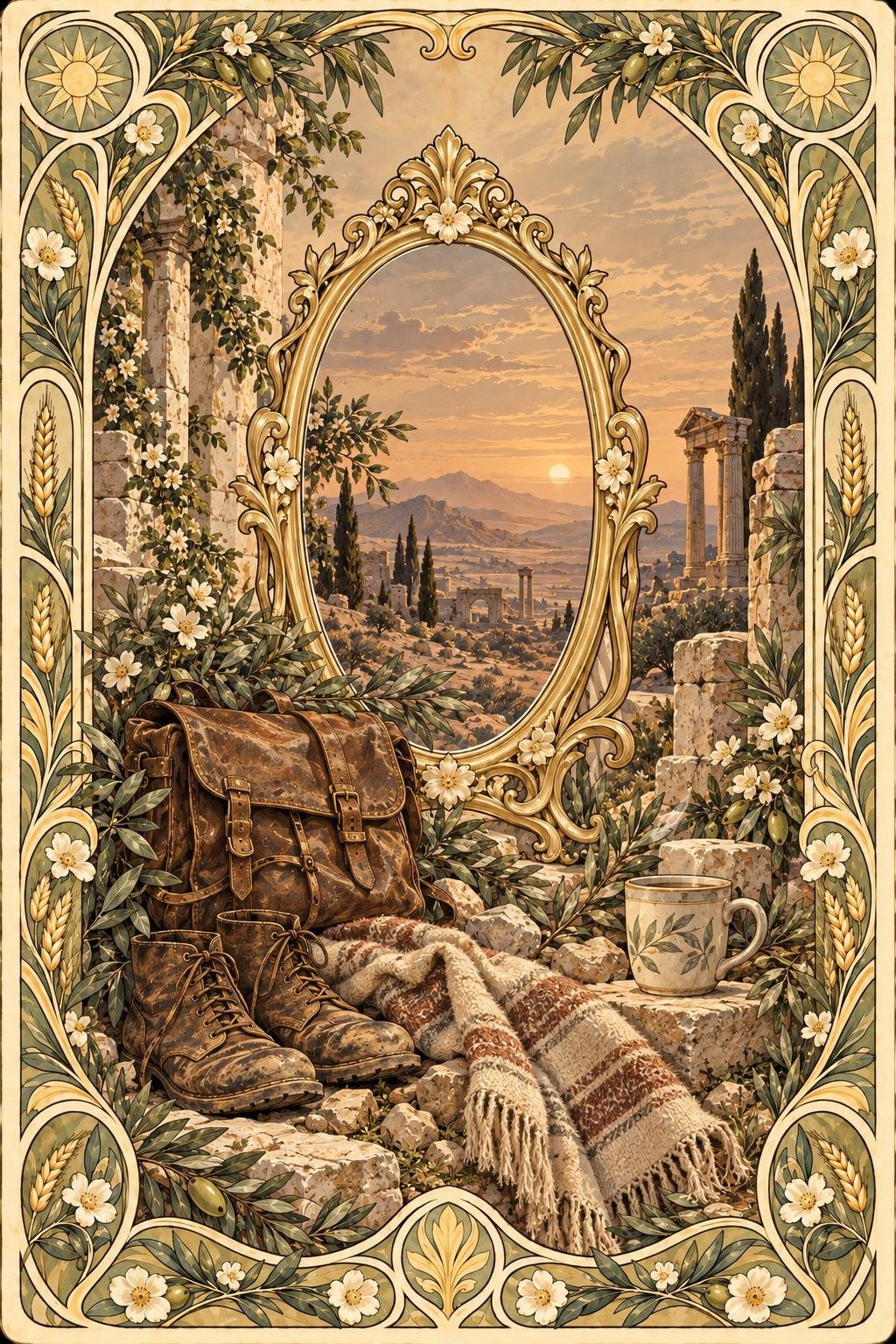
In the old sanctuary, the columns stand like quiet witnesses to countless ceremonies. Carved staffs and heavy books rest on the altar, each embossed with symbols of authority and knowledge. Yet today, the priest traces the familiar gestures without conviction. The words echo, but their meaning slips away, like incense drifting out an open window. The congregation sits on benches polished by generations, their attention fixed more on the grain of wood beneath their hands than the rite itself.
Beyond the stone walls, the market is alive with the routines of daily life. Stalls are covered with awnings woven from coarse cloth, stretched tight to block the midday heat. Sacks of flour and barley are stacked against the foundations, marked with the names of old families and trades. These materials—leather, hide, canvas—have no overt splendor, but they persist, weathering the passing seasons. On the edge of the square, a shoemaker’s apron, softened by years of handling, hangs beside tools worn smooth by use.
The local story tells of a teacher who, tired of empty rituals, sought clarity in the ordinary. She found it in the surface of a well-used cutting board, its edges rounded by years of preparing meals for those who came seeking advice. She learned from the pattern of door mats, braided from the stalks of last season’s wheat, that endurance is built from what is close at hand. The harvest field after reaping is quiet, with bundles of straw tied for animal bedding or for sweeping dust from thresholds. Nothing is wasted, though nothing is ornate.
Travelers along the dry highland roads find shelter beneath canvas stretched over makeshift frames. These coverings, patched and stained from long use, offer little in the way of ceremony but much in comfort. In homes, curtains of woven hemp hang in doorways, their coarse threads filtering the light and the wind. They take the place of costly tapestries, yet endure, doing the work of shelter and privacy where ritual has lost its place.
The wisdom in a reversed rite is to be found not in the grand performance, but in the repetition of gestures that shape daily life. A ledger with a cover of animal skin sits at the corner of a carpenter’s table, filled with notes and measurements. At dusk, children gather around a loaf cooling on a thick wooden board, the crust marked by the hands that shaped it. The world is held together by such things: not ceremony, but the tasks performed quietly, over and over, until they hold their own meaning.
Today, someone might sweep their step with a straw broom, listening to the sound it makes on stone. They could mend a torn bag, threading a needle through sturdy cloth by the window’s light. They might copy a recipe onto a fresh page, the paper thick beneath their hand, or tie a bundle of dried grasses for their hallway. Each task returns meaning to the shapes that have held it for so long.
Today's lucky color is Tan.
Lucky Color: Tan — #D2B48CLet humble routines renew the spirit.
Meaning can be found where hands meet what endures.