The card’s figure, encircled by a wreath that never quite closes, stands at the threshold. The ribbon’s knot, once clasped, is now slack; the hands have left it, their work paused in mid-gesture. Around her, four forms watch—the bull, the lion, the eagle, the person. They do not speak but seem to wait, gazes fixed on the gap in the garland. She is neither inside nor out, a traveler at the border of two states, with one foot still on the stone of the old city. A breeze stirs the leaves above her head, the oldest leaves, thick and twisted, the kind that remember drought and wind.
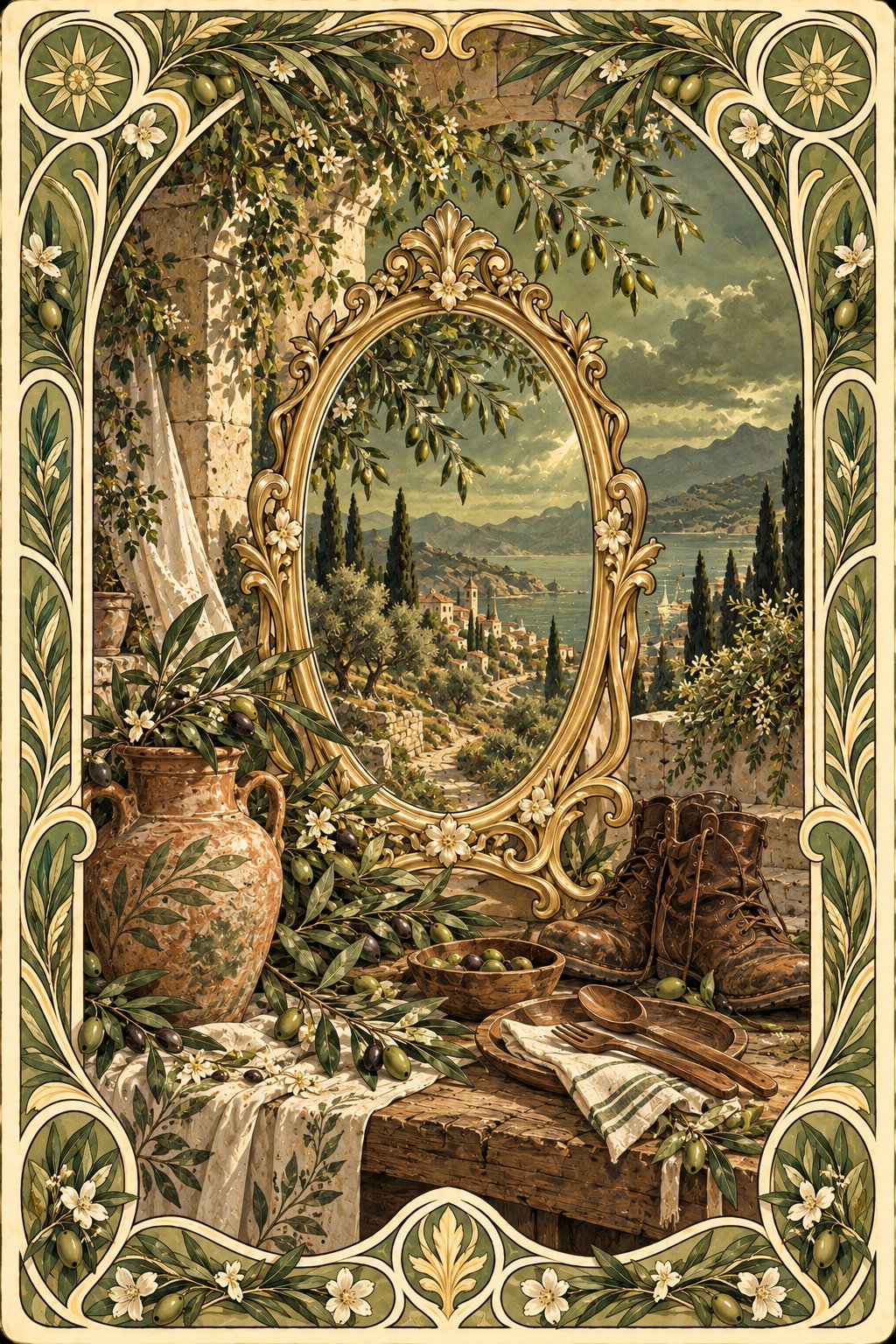
She stands at the edge of an olive grove in late summer, where grooved trunks spiral from ancient roots. The trees are short, their crowns dense, and the ground beneath them holds the bitter fruit of last season. In the shade, baskets for harvest rest upside down beside a wooden pitchfork, its prongs worn smooth. The air here is heavy with the smell of pressed olives, metallic and sharp, and the soil is scattered with fallen leaves and the glint of snail shells. Beyond the grove, the hills are lined with terraces, each wall stacked by hand, stone on stone, decade after decade. It is a place where endings and beginnings blur—where the last fruit is picked, but the work is not yet done.
In the myth of Athena, the goddess stakes her claim to the city with a single gift: the tree that outlasts fire and siege, its branches twisted into wreaths for victors, its wood carved into tools and bowls. The people who tend these groves work in the stillness before dawn, hands stained with oil. They know the patience of slow ripening. Some seasons, the harvest fails, but the trees remain. In every kitchen here, heavy jars hold what was pressed and saved, with a layer of residue at the bottom—reminders of what lingers when the feast has passed.
Travelers on the old Roman road pause at a small inn, where the roof beams are made from the same wood as the groves. On the hearth, a kettle simmers, steeping leaves gathered from wild shrubs at the grove’s edge, sharp and resinous. The air is thick with the smoke of branches burned for winter warmth. A shepherd brushes dust from his cloak, woven from the coarse wool of sheep that graze between the trunks. He sits in the doorway, looking out as clouds gather over the low hills. The sky is a lid, heavy and waiting, and the scent of rain is distant but certain. The wind comes, carrying the promise of weather turning.
In the city, vine leaves hang from a veranda, shading the midday table. Here, a woman grinds herbs with a mortar made from ancient stone, her hands steady from years of repetition. She listens for the rattle of dry leaves in the yard, the sign that autumn is near. On the windowsill, a row of glass bottles holds oil and brine, and a loaf of bread—crust thick, crumb dense—rests beside a shallow dish. It is a meal for the interval, to be eaten while waiting for what comes next.
Today, a person might walk beneath old trees, gathering stray leaves to press between the pages of a book. They could polish the handle of a wooden tool, or stir a pot of herbs and oil left to steep on the stove. In the afternoon, it is good to sit by a window as the weather changes, hands busy with mending or sorting through a basket of forgotten things.
Today's lucky color is DarkOliveGreen.
Lucky Color: DarkOliveGreen — #556B2FThere is wisdom in pausing just before the knot is tied.
The interval is fertile ground.