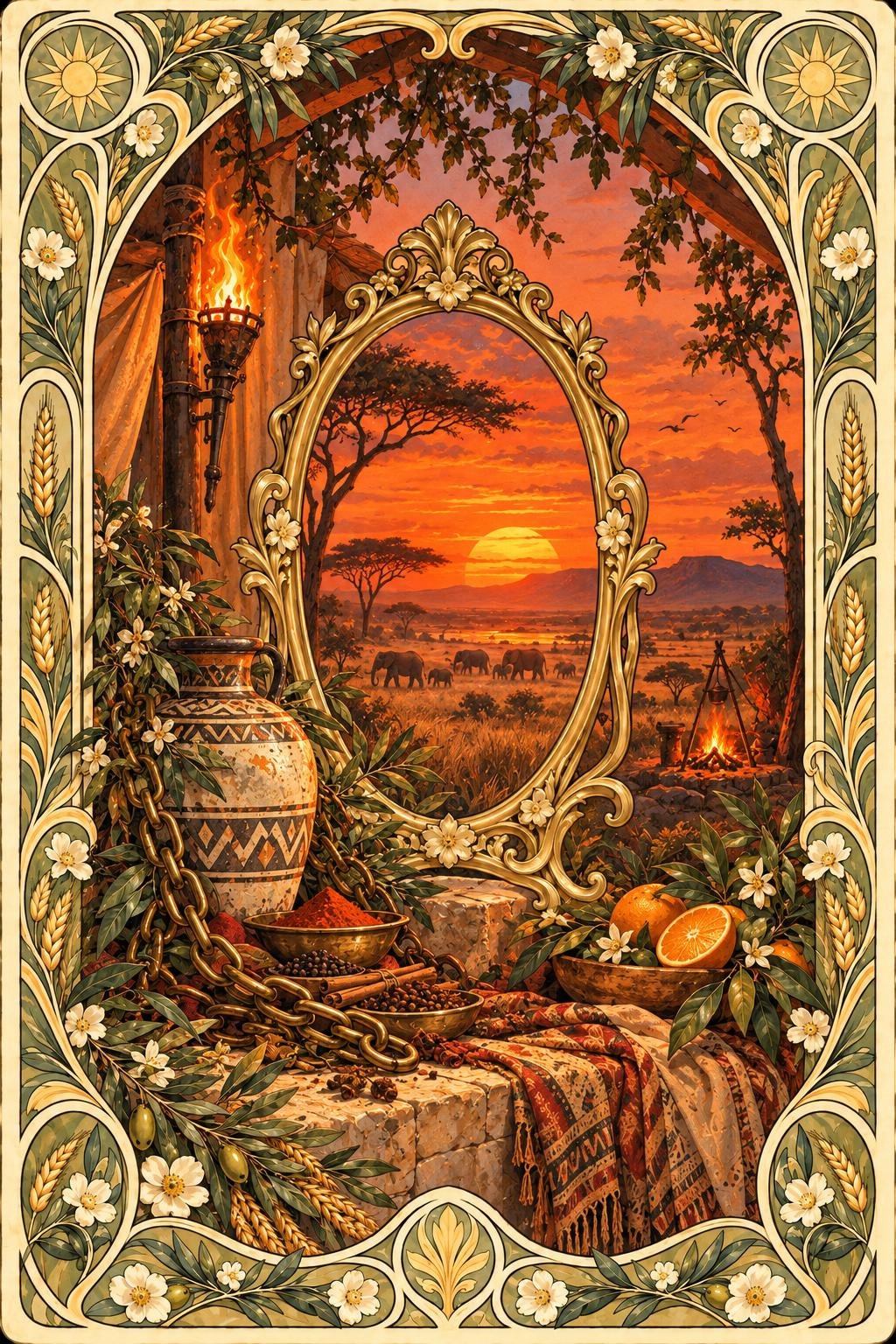
In the lamplit chamber of The Devil, a pedestal stands. Upon it, a half-burnt torch flares, its flame dancing with a restless appetite, casting flickering shapes against the stone. Around the base, heavy links are draped, but the chains are slack, their iron waiting for will or neglect to decide their tension. Here, desire is not a jailer but a tool—so long as its face is named and its light is seen.
A cave’s mouth opens in a faraway plateau, the color of the kindling that feeds mountain fires. Along the Silk Road, merchants once traded lacquered boxes carved from rare wood, their surfaces polished and coated until they glowed like embers caught beneath a bellows. In kitchens, the heart of a hearth glows as fresh coals are raked, sending up a heat that can melt the rigidity of old habits. The chains resting at the Devil’s feet are not fixed; they are like those used by blacksmiths, drawn loose when the task requires freedom, tightened only for shaping. Above, the torch evokes the bonfire that signals both warning and invitation—a tool for gathering, a sign to those who watch from the dark.
There is an old story from the Mediterranean coast, where fishermen would wait for the sky to clear after a storm. The moment the clouds parted and the first rays touched the wet clay roofs, it seemed as if the very houses caught fire, burning with a fierce hope. These roofs, made from earth and shaped by hand, once cooled in kilns until they carried the memory of heat—a reminder of transformation through flame. Travelers learned to spot such roofs from afar, knowing they marked villages where warmth and food could be found, and perhaps a cure for loneliness.
In the marchlands of Asia, the torch’s twin lives in the fields: chili pods strung to dry on twine, their skin taut and glossy, promising both pain and release. These pods, harvested at the height of summer, hold within them the same power as the torch on the pedestal—the capacity to awaken and to overwhelm. In the evening, cooks grind them with mortar and pestle, releasing a fragrance that fills the air and draws neighbors together. The mortar itself, a simple bowl of fired earth, is a pedestal in miniature, and the grinding, an act of shaping raw desire into sustenance.
Desire, the torch, the chains—they are not to be feared, but understood. A person standing before the pedestal can choose to lift the torch and walk forward, or let the chains fall away with a simple slackening. The torch can light a path through fog, or serve as a warning against what lies ahead. The chain can secure a boat against a river’s pull, or be coiled and stored until its use is clear.
Today, a person might place a terracotta bowl on their table and fill it with late-season peppers, or gather storm-fallen twigs to kindle a fire for evening warmth. They can seek out a lacquered trinket, running their fingers over its glossy surface, contemplating the effort that transformed raw wood. Or, in the hush before sleep, they can write down one longing they wish to shape, setting it beside the flame of a candle to be seen, not hidden.
Today's lucky color is OrangeRed.
Lucky Color: OrangeRed — #FF4500A day for lighting torches, unfastening what binds, and cooking up courage.